An EMR for eye care professionals.
ROLES
Co-founder
Principal Designer
Principal Engineer
Technical support
PERIOD
January 2023 onwards
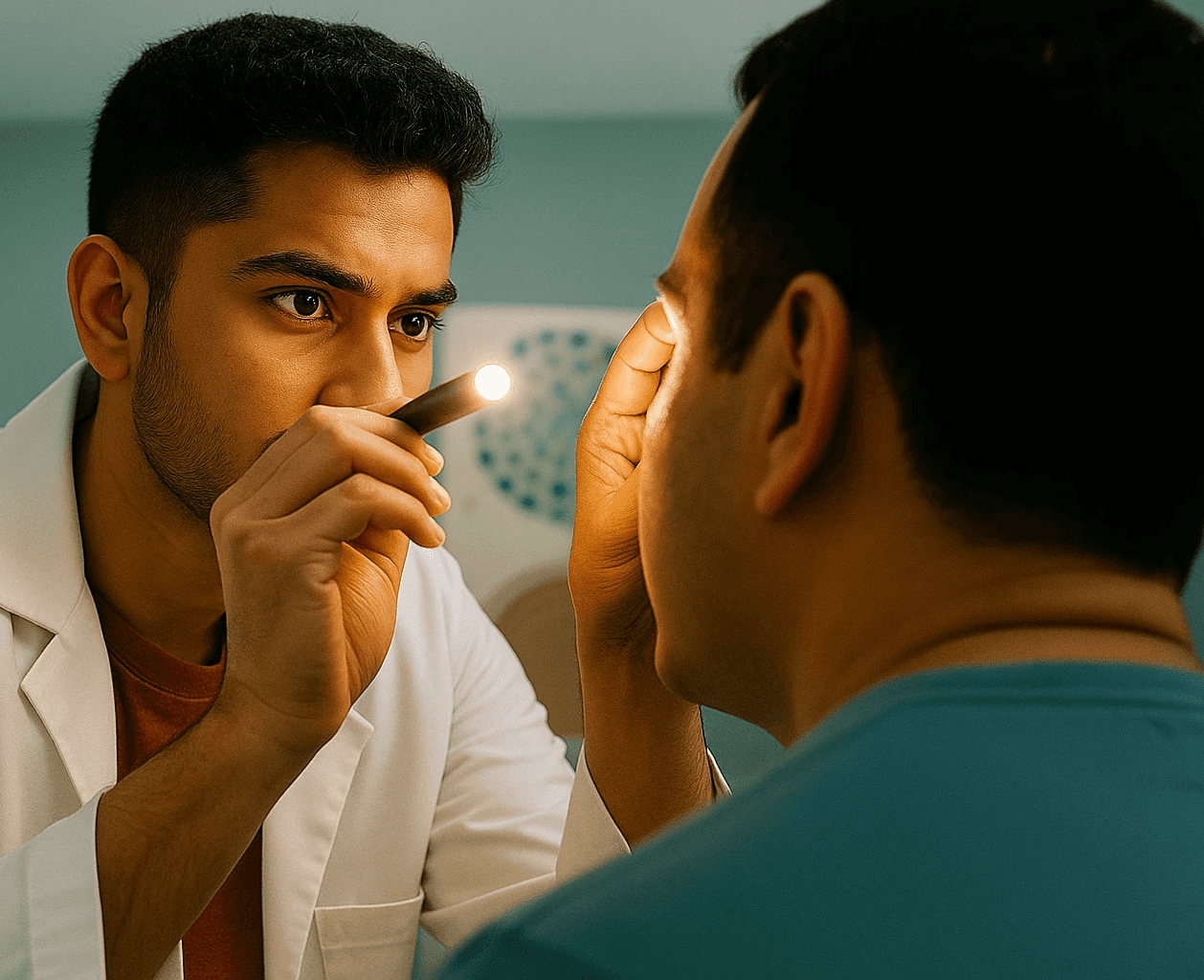

EMR is one the core features of ASIRA Clinical, offering a comprehensive, clinically aligned, set of optometry and ophthalmology specific tests, modules, and test templates aimed at reducing ambiguity and increasing accuracy in clinical decision making.


Challenge
Practitioners are unable to comprehensively document a discharge summary with all the tests they perform during an eye exam due to a lack of time, expertise or availability of tools to record this data. As a result, patients do not get a complete picture of their ocular health, often ignoring serious conditions like keratoconus, glaucoma and myopia till it's too late.

Solution
Launched a browser-based EMR tool with over 60 validated tests and modules, guided templates for common vision disorders and AI for clinical suggestions, helping practices save time in clinical decision making and increasing accuracy of diagnosis.

Impact
onboarded
~150
hospitals and clinics over 3 years helping them move from paper to digital, saving time and money.
REDUCED CHAIR TIME BY
~ 50%
by auto-populating previous test data, using pre-filled patient history forms and using AI for faster clinical analysis.
INCREASED FOLLOW-UPS BY
60%
using automated WhatsApp reminders a day before the booked follow-up appointment, with an option to reschedule.
Avg. revenue increase of
₹ 250-300
per consultation as patients value more comprehensive reports sent digitally, and a professional clinical experience.
time saved per day
1-3 hours
Since reports are automatically created and sent to patients digitally, there are no paper reports to complete.

~11 minutes
eNHANCED CLINICAL EFFICIENCY BY OFFERING
60+ tests

in-depth version

This case study is a review of ONLY the EMR side of ASIRA. For a deeper dive into how and why ASIRA came to be along with a comprehensive look at it's features, click the button below.
Read the case study
Planning the UX
Identifying required Tests and form fields
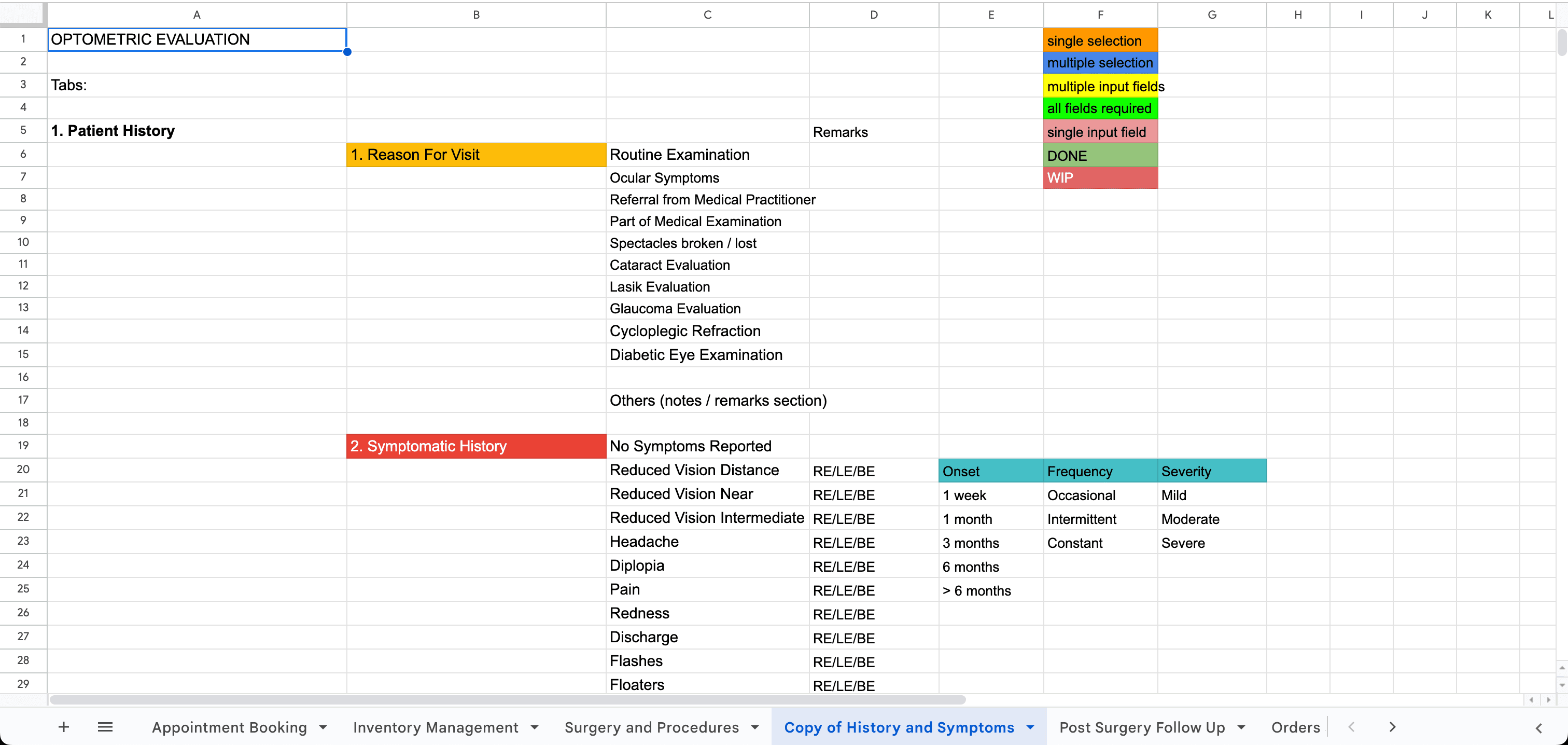
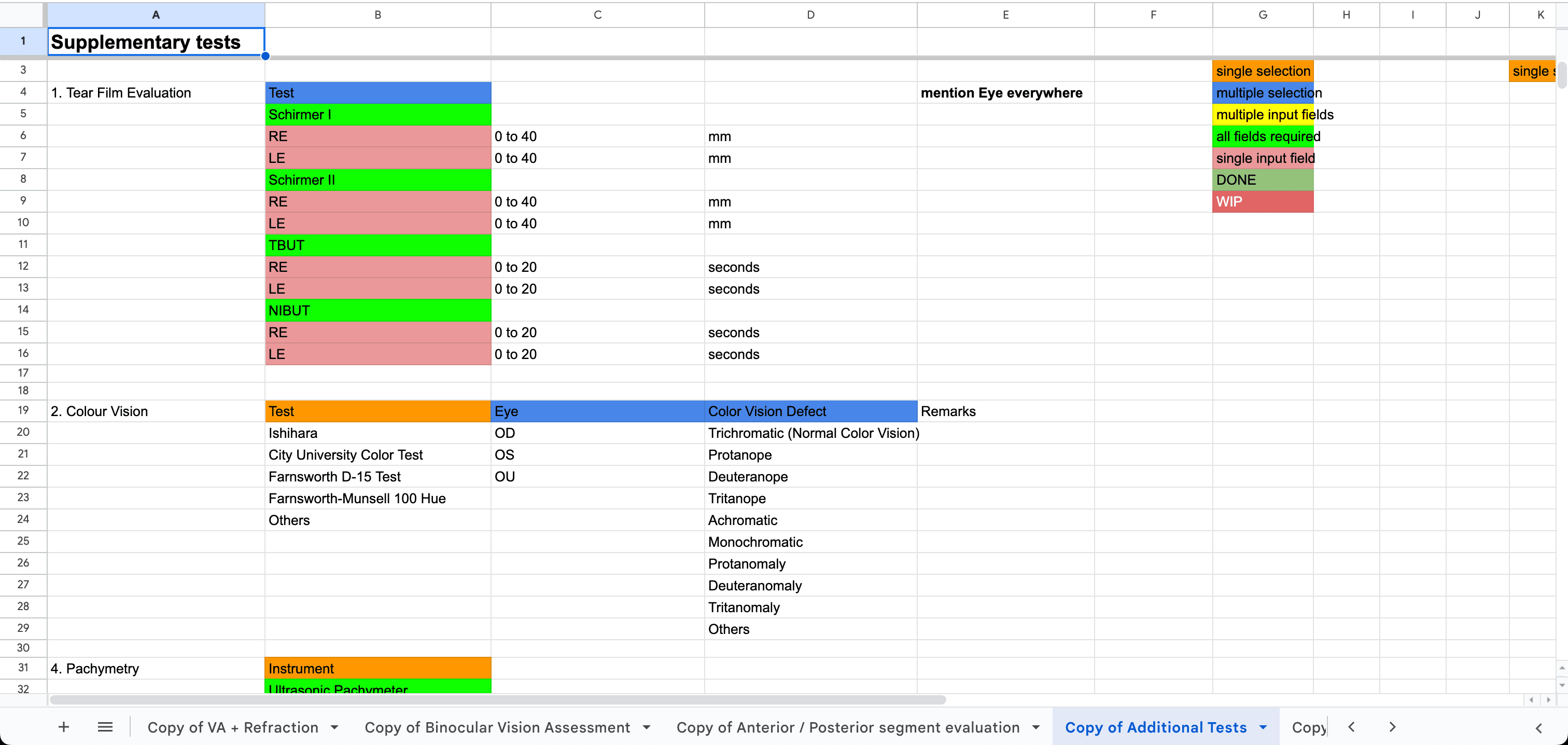
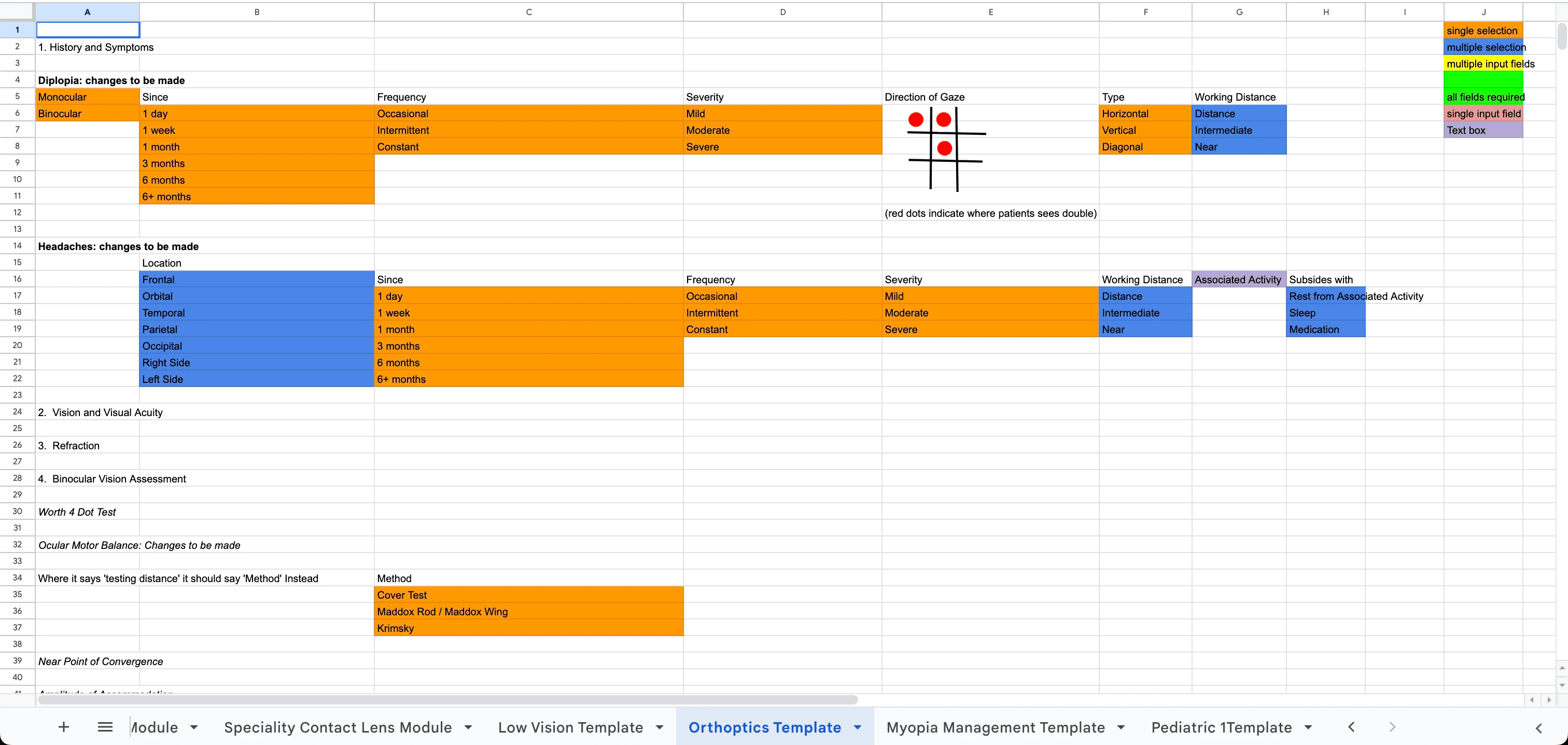
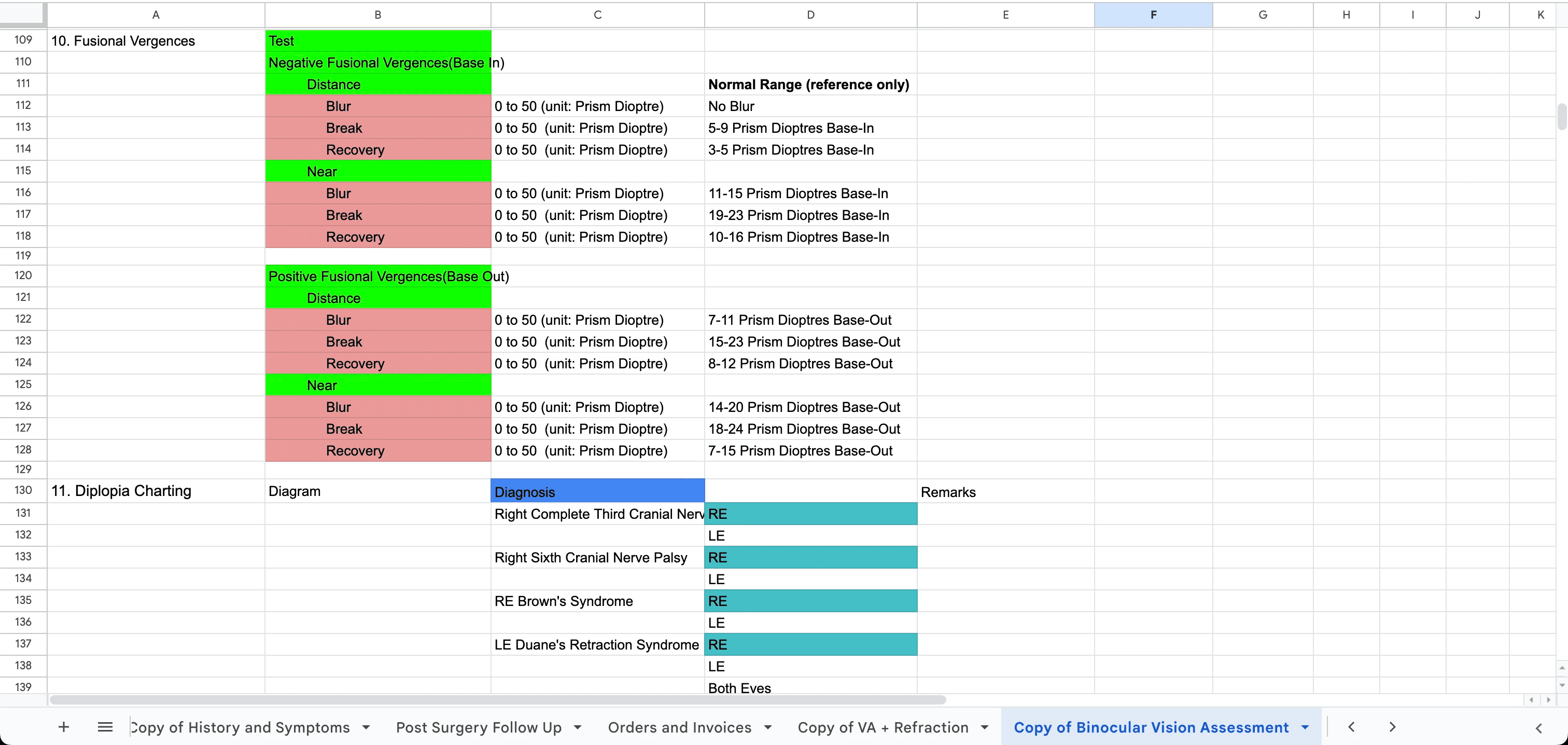
The clinical team created spreadsheets detailing the different fields required for each test. They also highlighted single choice, multiple choice and input fields along with default values.
Establishing a hierarchy
Tests
A series of steps performed on a patient to assess various facets of their ocular health.
Modules
Collection of tests grouped together by the type of patient ocular data recorded.
Templates
Collection of modules grouped together to perform either a routine or specialised eye exam.
Creating a UI template
for test taking
As a template has a series of modules, I wanted to keep all elements of the page the same, while only changing the body of the test.
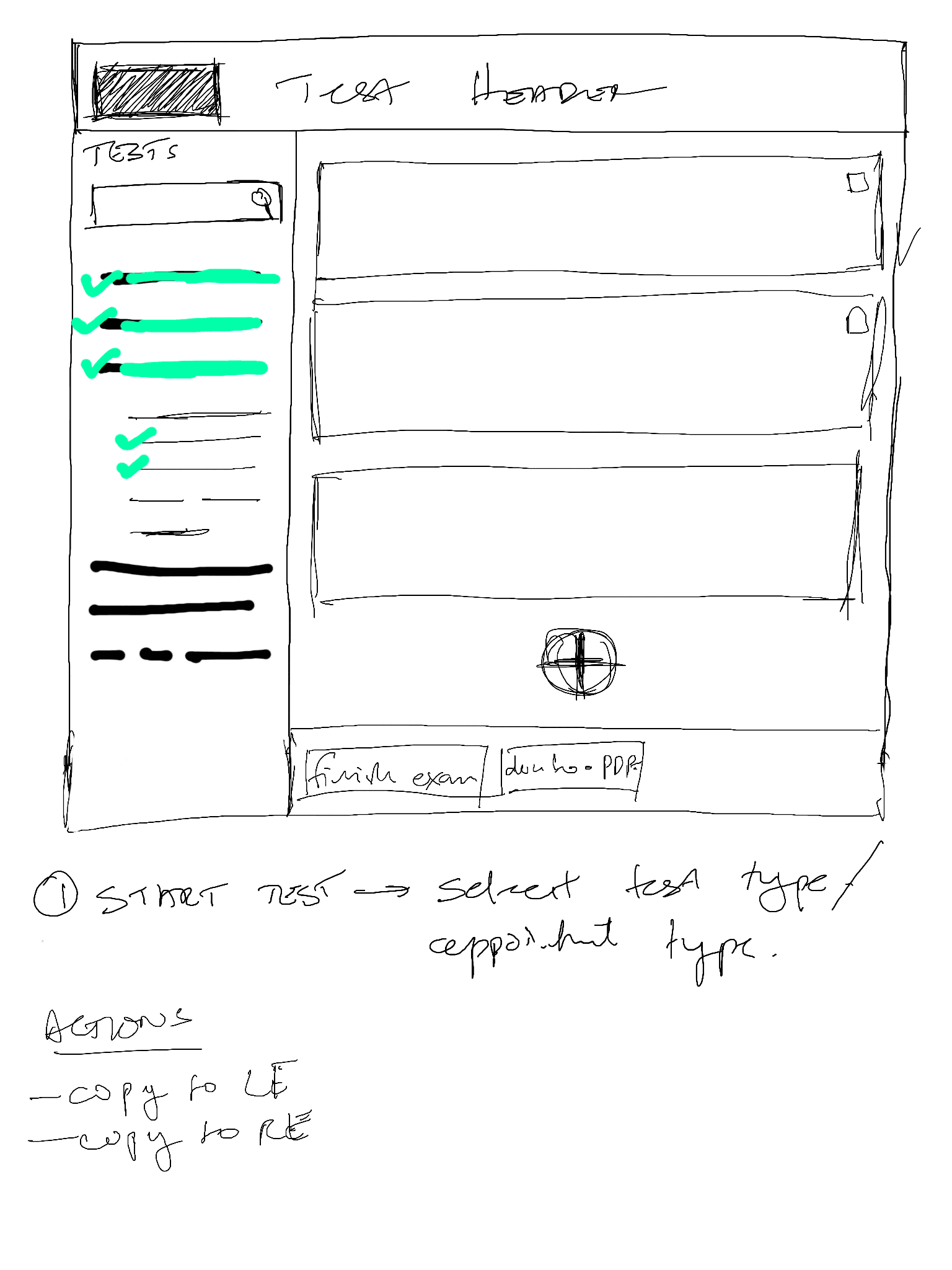
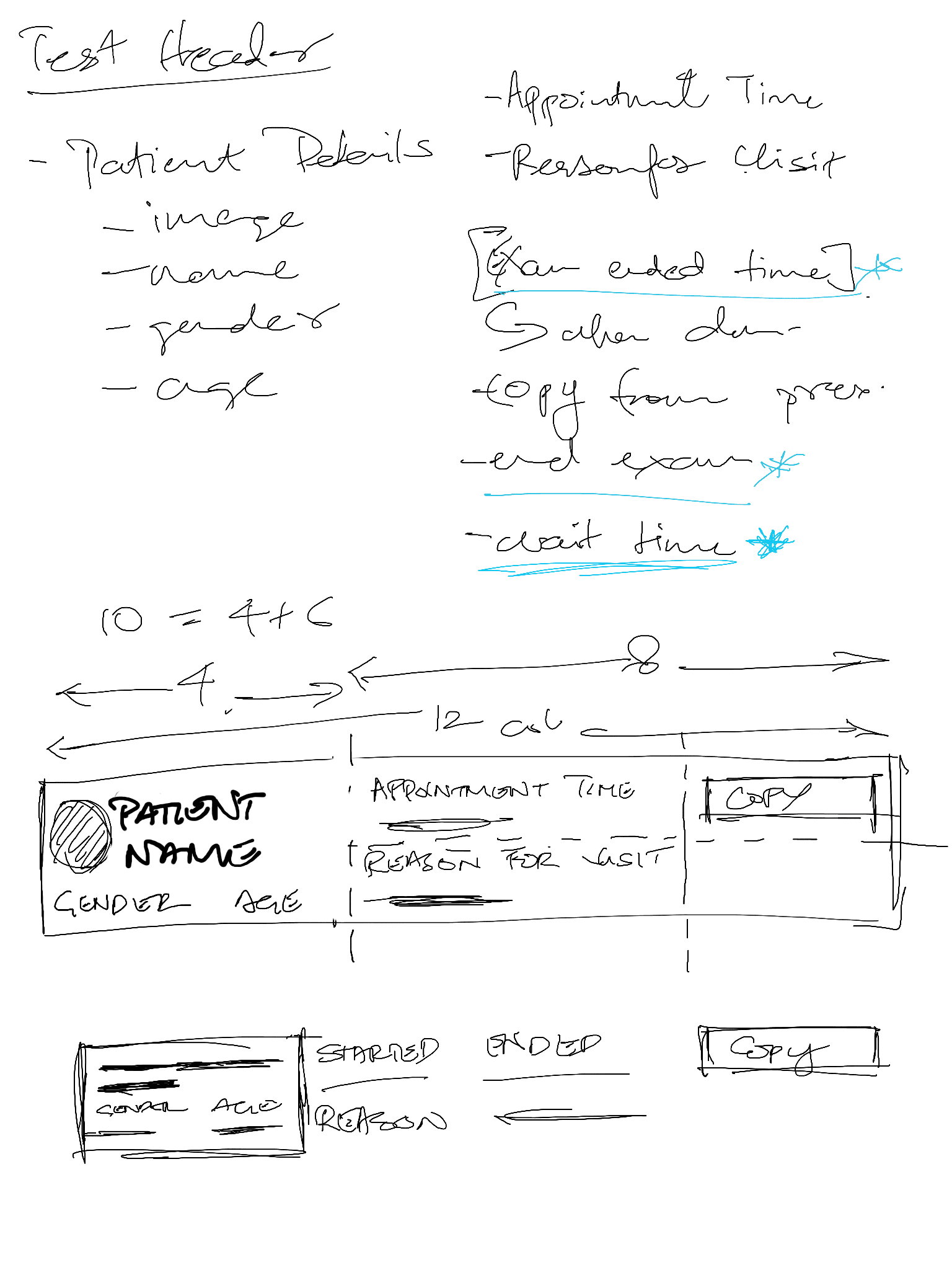
Early sketches to explore the data that needs to be available to the practitioner during an eye exam
Constraints
No editing after 24 hours
Legally, test results can only be edited for 24 hours after the test has ended. This is to prevent tampering of patient records.
No mandatory fields
Practitioners want to record as little or as much data about a patient as they need, without the restriction of mandatory fields.
Allow users to add notes
Practitioners often need to make additional notes beyond the standard form fields provided.
Reports should only be accessed After an eye exam is complete
The discharge summary and final prescription are reports generated at the END of an eye exam.
Affordances
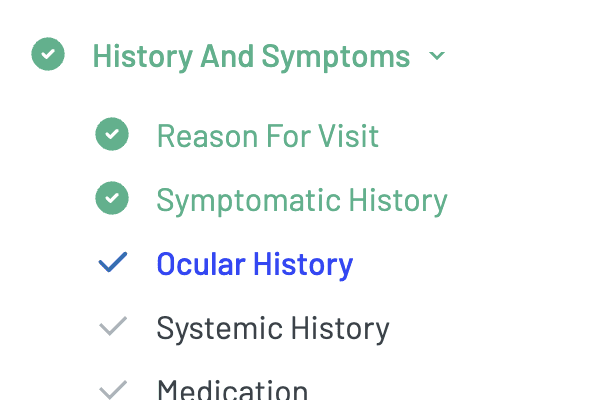
Auto Save on Every field change
We triggered state updates each time the value of a field changed. This allowed practitioners to seamlessly record test data without having.
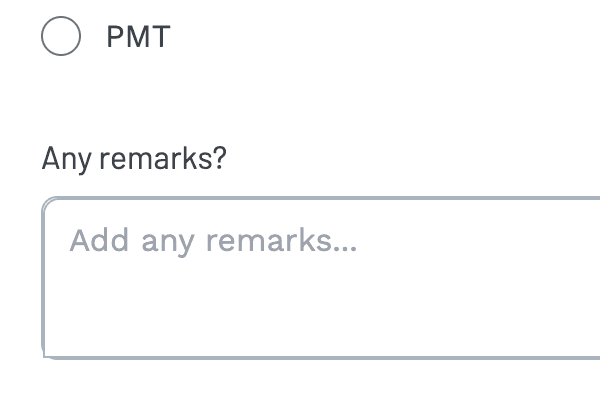
TextBox for Remarks in all tests
We added a text field where the test taker can add extra notes.
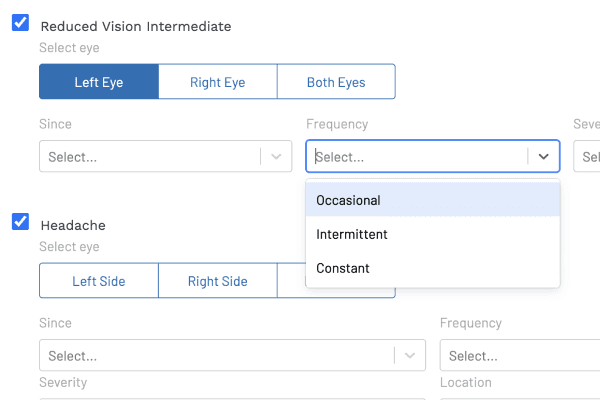
Fewer inputs, more clicks and selections
To enhance the guided experience, we replaced input fields with pre-filled dropdowns and buttons, reducing human error due to manual input
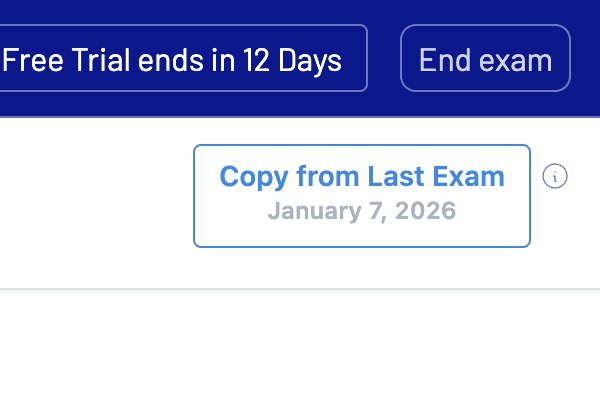
Copy from Previous
Populates current eye exam with data from the last eye exam, only needing to edit 30% of the fields, instead of having to rewrite the entire history.
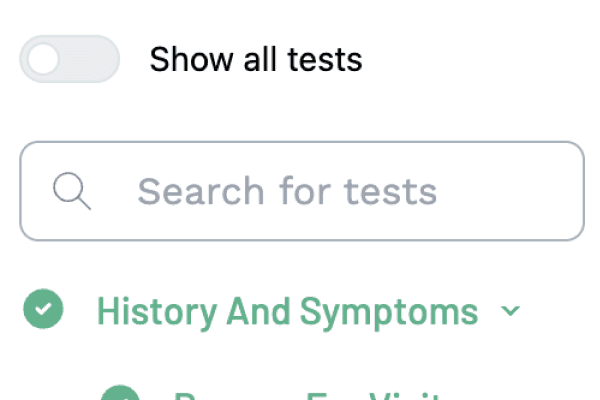
Show all tests
Sometimes practitioners need to perform additional tests. For this, we added a 'Show all tests' button displays all the standard tests.
rECORDING Test Data
All eye exams start by taking a patient history and end with providing an action and advice.
The patient history is required to determine which tests the practitioner performs during the eye exam, while the action and advice prescribes the next steps that need to be taken by the patient after the exam is done.
First step
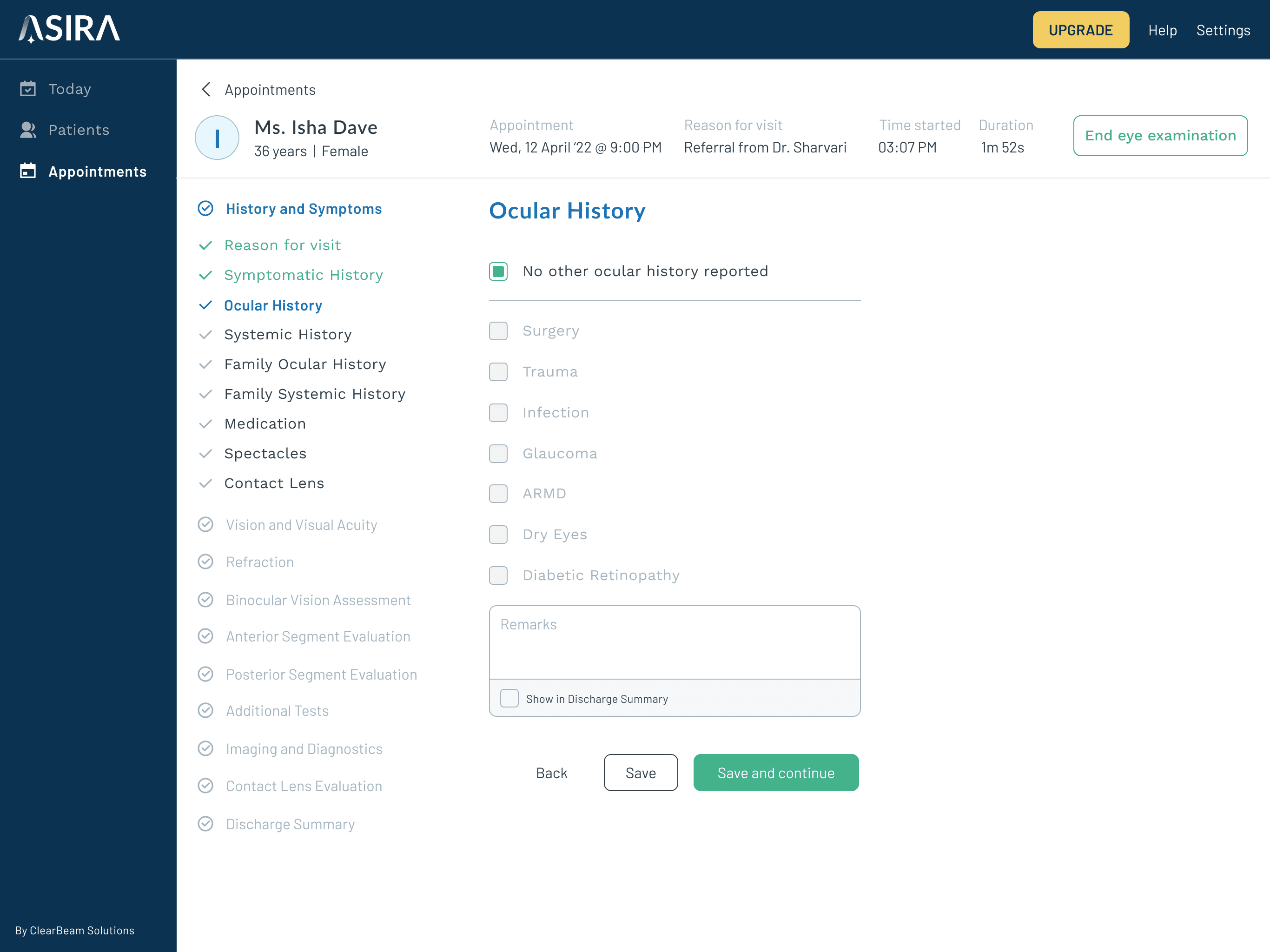
Collecting patient history
Taking a patient history is the fundamental first step to starting an eye examination. An accurate patient history is required for an optometrist to decide the set of tests that need to be performed during the exam.
Family history, ocular history, history of symptoms and lifestyle information are key details that need to be captured correctly for an accurate diagnosis.
Symptomatic history
Records data about the symptoms that the patient is experiencing.
systemic history
Record data about existing long-term health conditions.
Lifestyle
Record data related to screen time, time spent outdoors, profession, hobbies, etc.
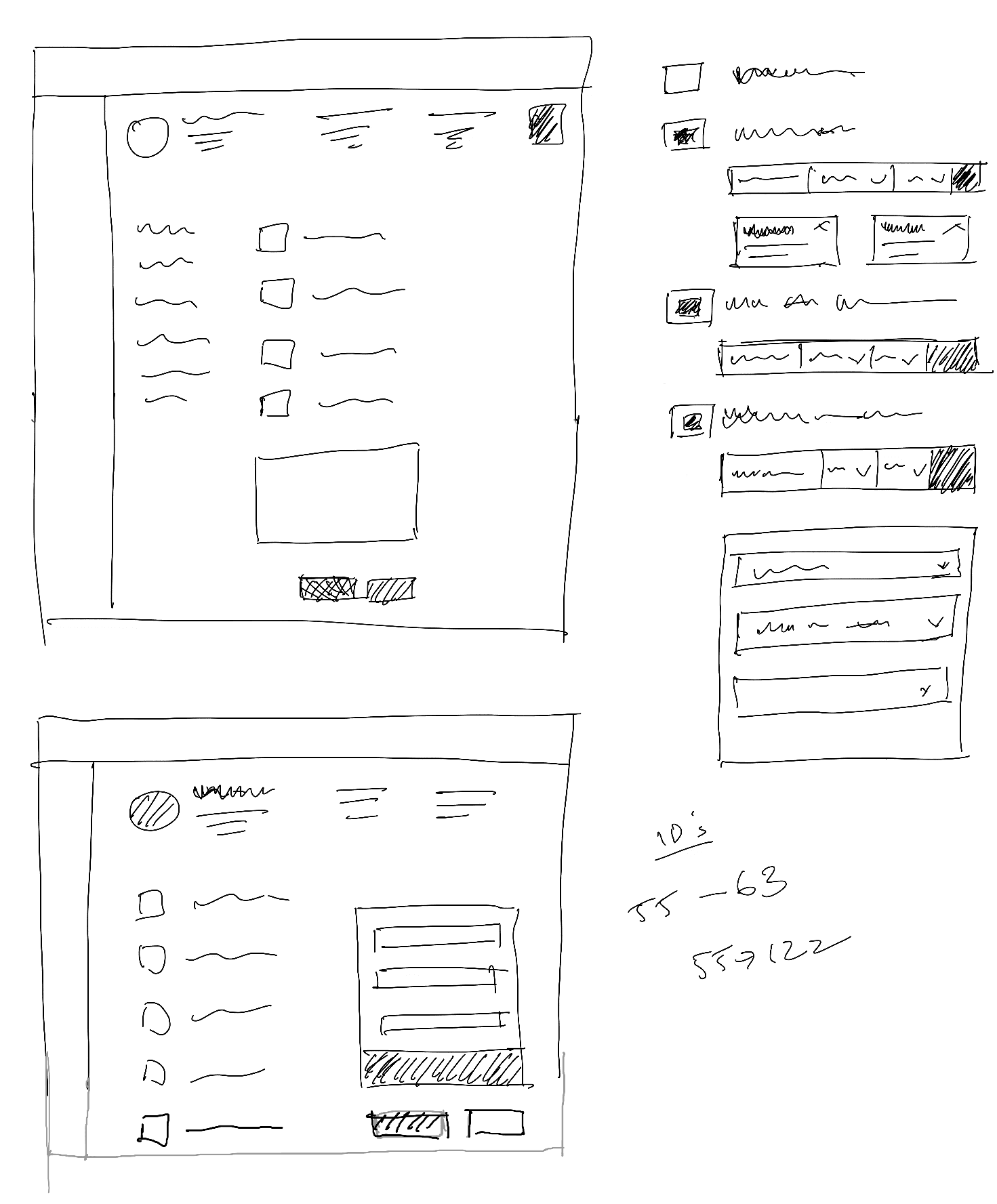
Final Designs
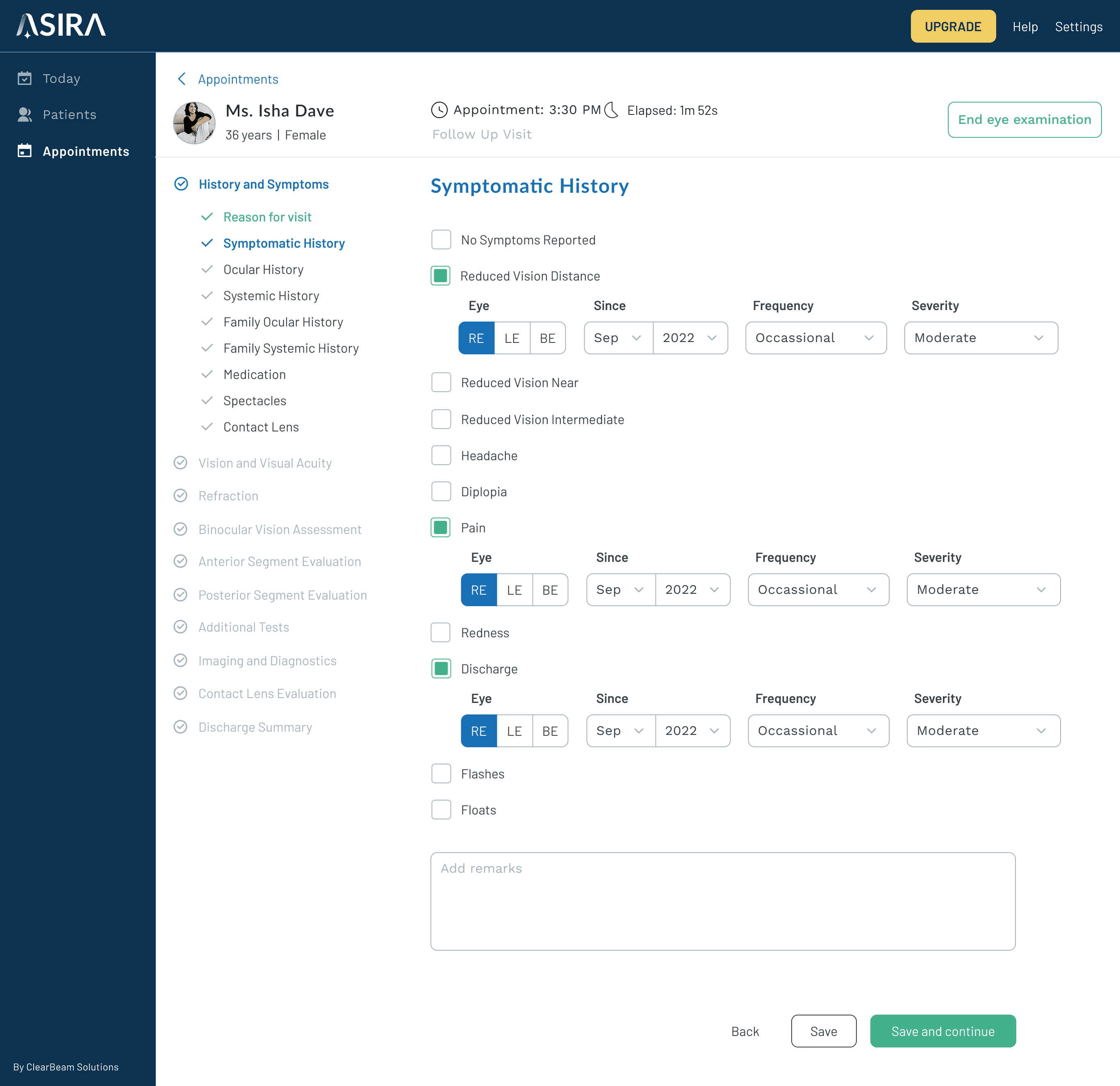
acuity and refractive Tests
Acuity and Refractive tests measure how well a patient can see by performing tests that are both, objective and subjective.
Recording a prescription (Rx)
To create a spectacle or contact lens Rx that a patient can use, an optometrist has to perform an Objective and Subjective Refraction to obtain the patient's eye power which is a combination of four values:
Sphere (SPH)
the lens power needed to correct nearsightedness or farsightedness.
Cylinder (CYL)
indicates the amount of astigmatism, a vision condition caused by an irregular shape of the cornea or lens.
Axis
a number between 1 and 180 that specifies the orientation of the astigmatism correction on a lens.
Addition (ADD)
the lens power needed to correct nearsightedness or farsightedness. This value is optional.
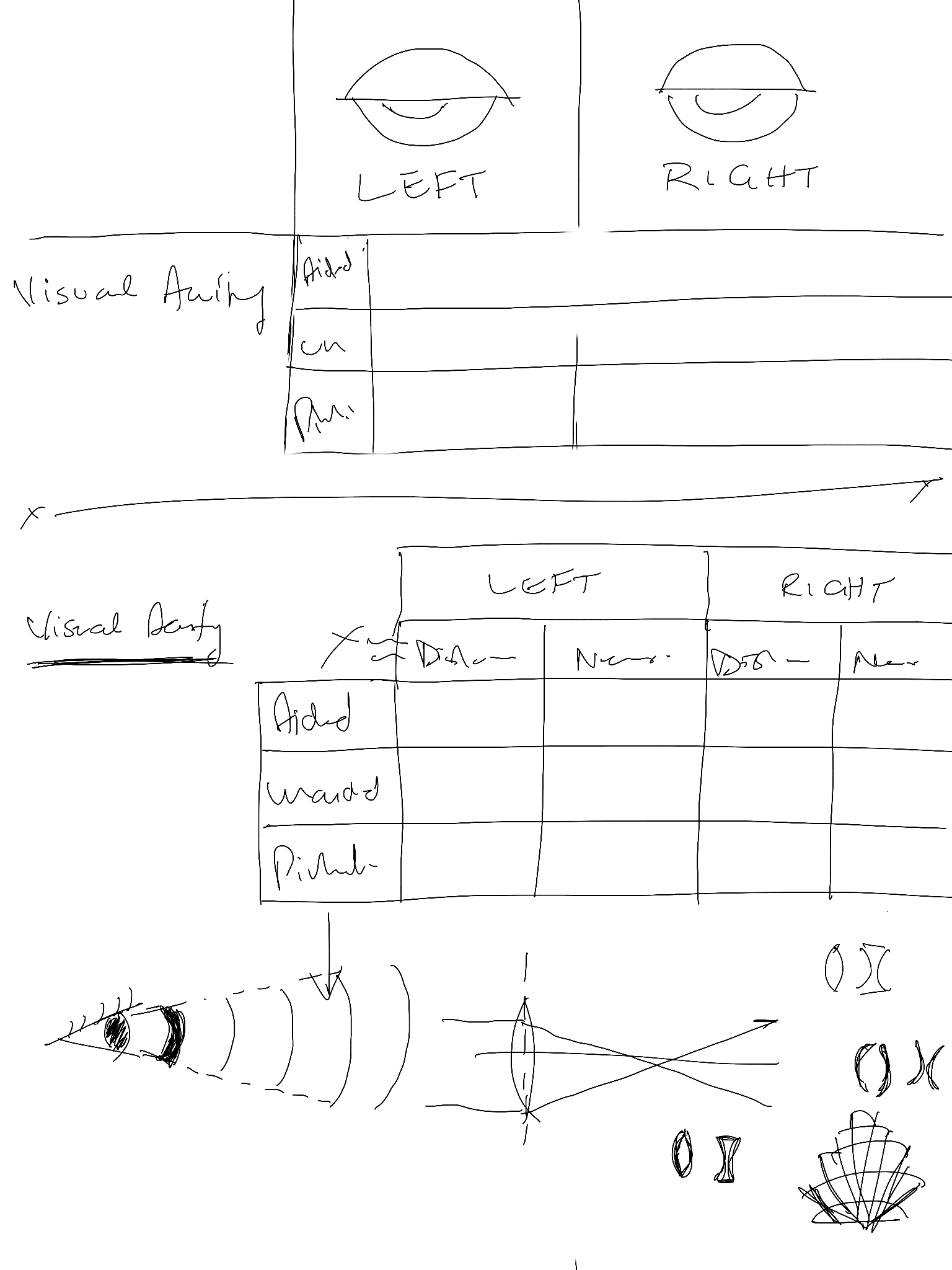
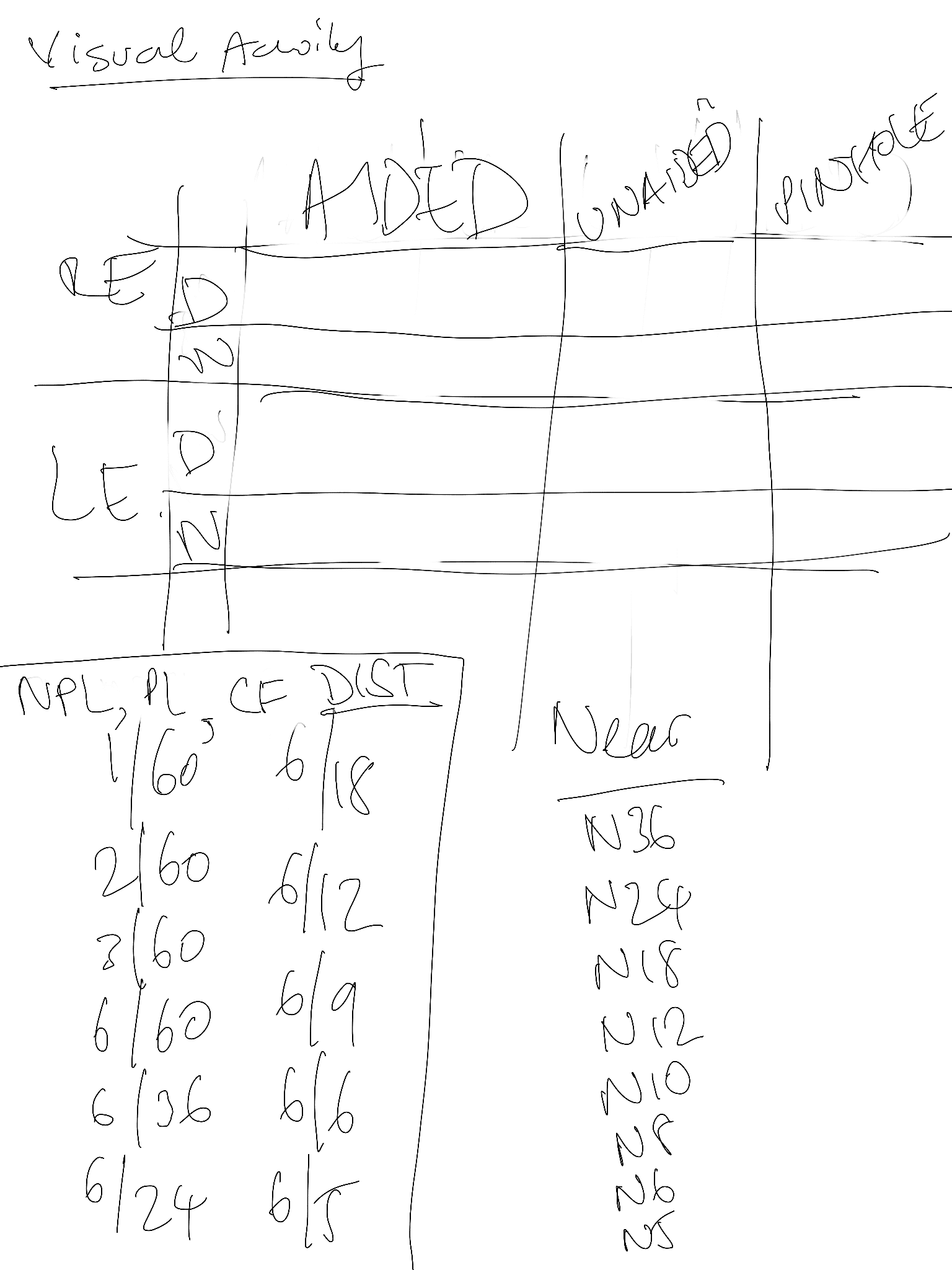
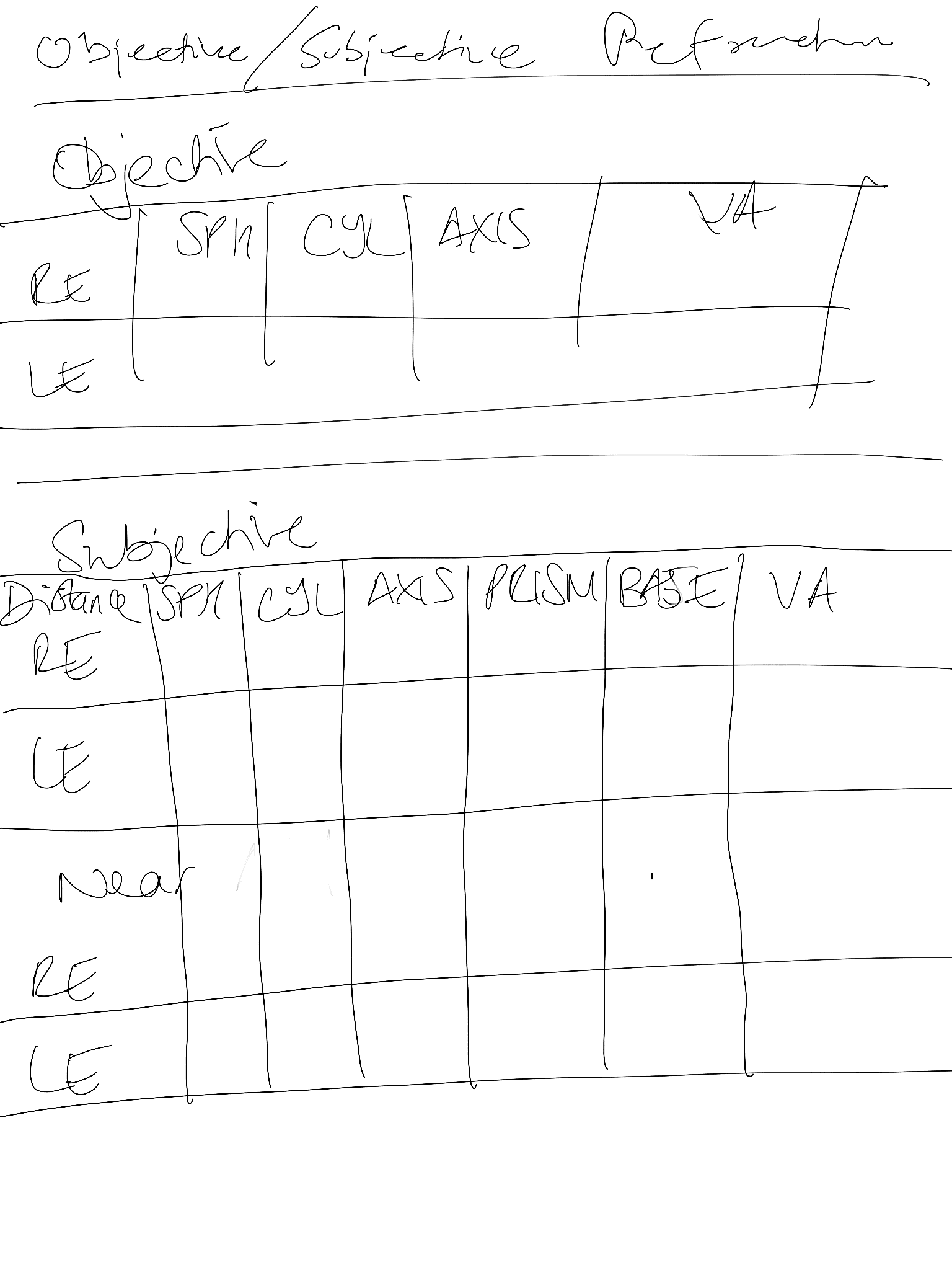
Notes about how the prescription table needs to be designed. The Right Eye (RE) values should always precede the Left Eye (LE) values as per convention.
Final Design

Final design of the Objective-Subjective Refraction test.
Ocular Structure Evaluation Tests
WHat does it do?
BVA assesses how well your two eyes work together as a team, checking their coordination, alignment, focusing ability, and depth perception to create a single, clear 3D image.
Why is it important?
Identifies issues affecting reading, concentration, and visual processing.
Drawing Tools
Optometrists ❤️ drawing tools!
Drawings allow practitioners to accurately communicate to the patient and referred practitioners, the ocular defects that are affecting the patient.
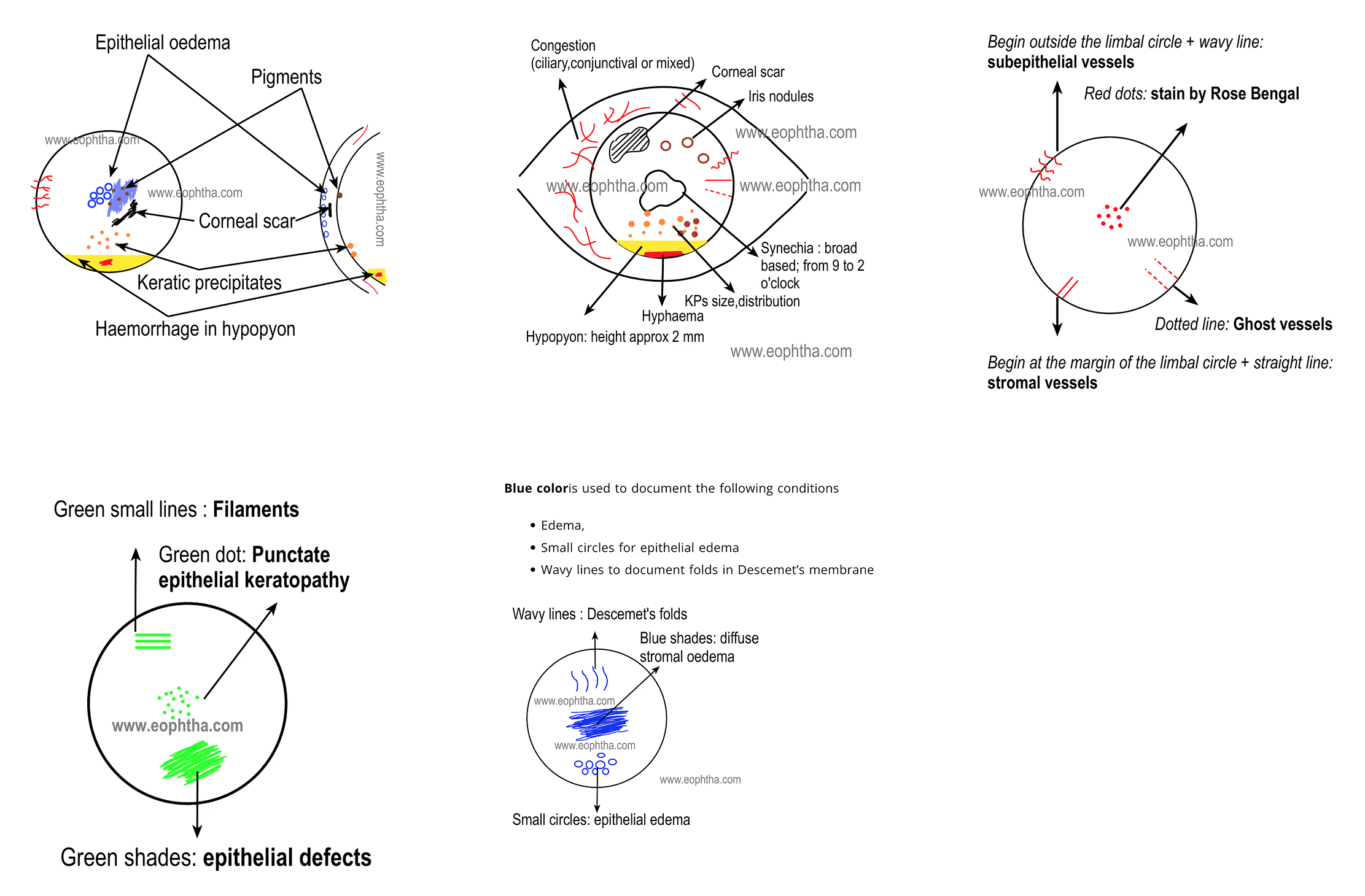
Examples of ocular diagrams recorded by eye care practitioners during an eye exam.
The diagrams above are examples of Anterior and Posterior Segment Evaluation diagrams.
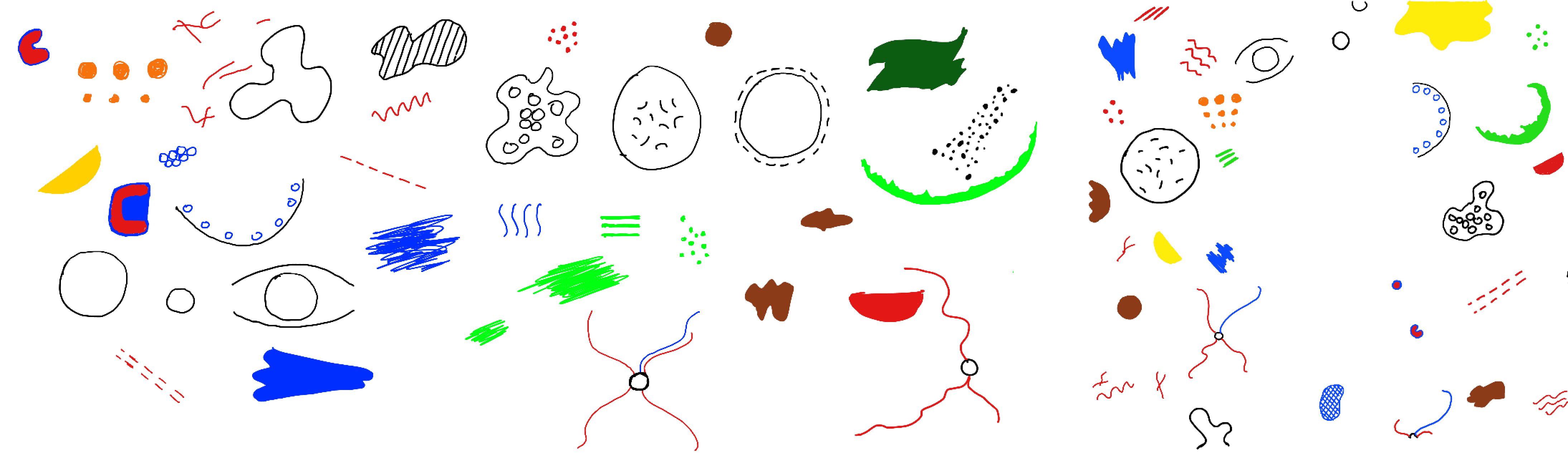
Quick sketches in Procreate to recreate the various eye conditions that needed in the drawing tools. I used these sketches to create icons for the drawing tools
I created a set of icons for various ocular conditions that users can add to the diagram. This is one of the most loved features!
Right: Wireframe for the toolbar
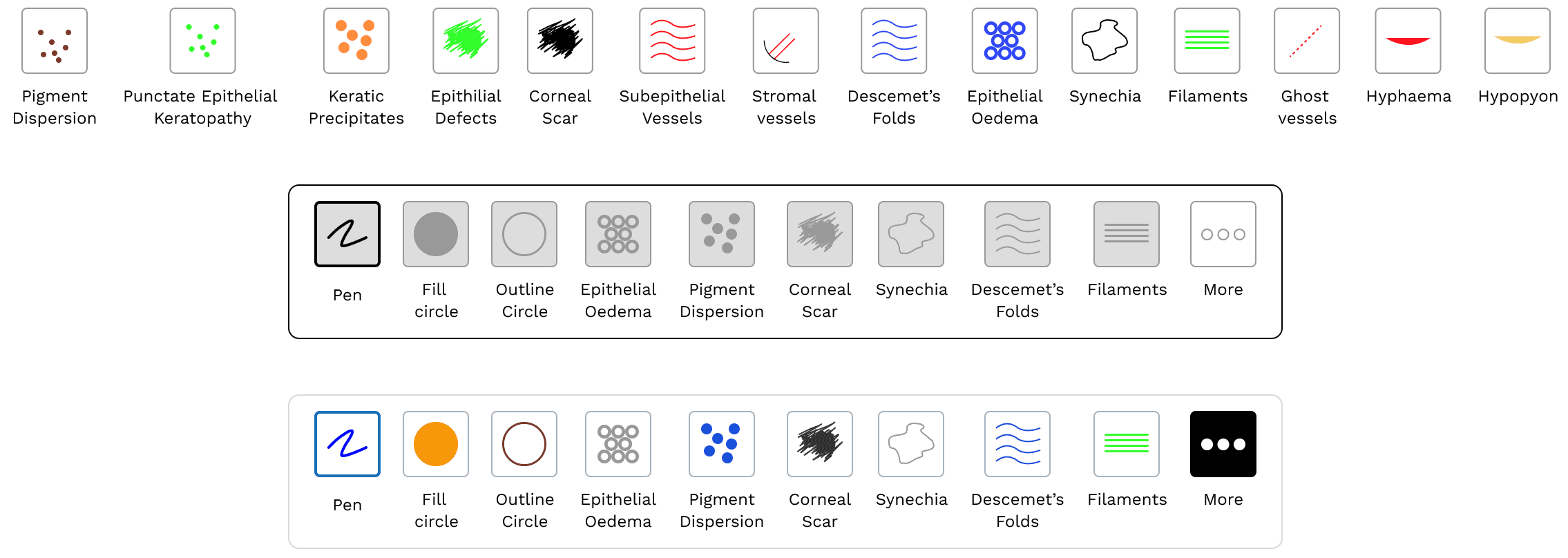
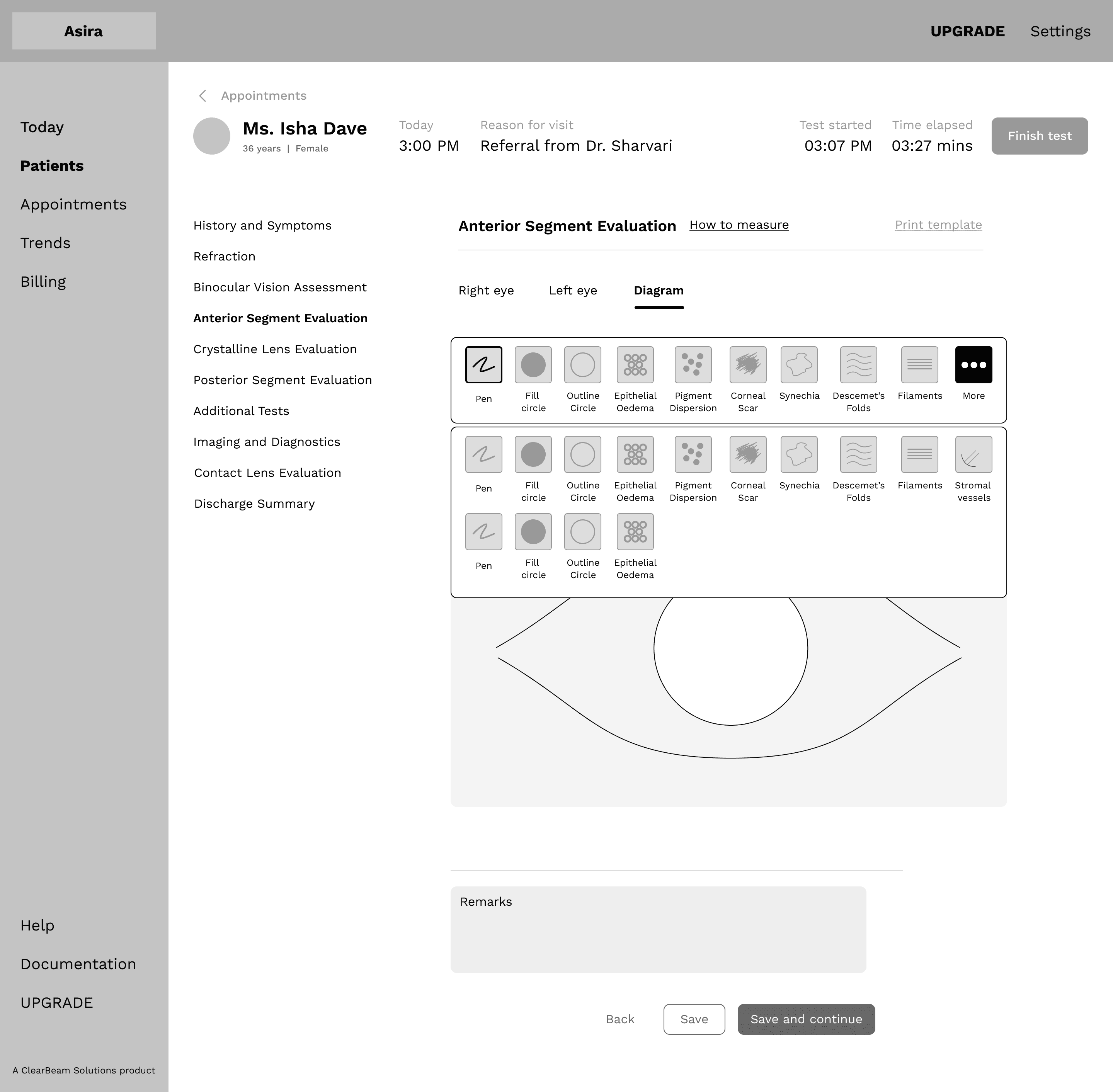
Drawing tools in action! The code uses Konvajs to draw on the canvas element and saves the image to an S3 bucket.
GRADING SCALES
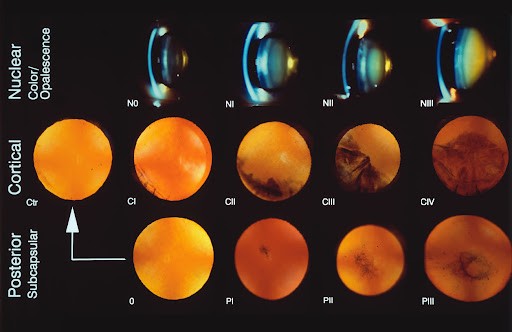
LOCS III Grading Scale
Grading scales are standardized systems used by practitioners to grade the severity of age-related cataracts based on the appearance of the lens. It uses a decimalized scale to grade four types of cataracts: nuclear opalescence (NO), nuclear color (NC), cortical (C), and posterior subcapsular (P).
Traditional Approach
Typically, practitioners compare a patient's cataracts to a set of photographic standards under a slit lamp to find the nearest match on the grading scale.
Using ASIRA
Users can upload images of the patient's cataracts and compare them with the corresponding scale on the left making it easier to read and compare.
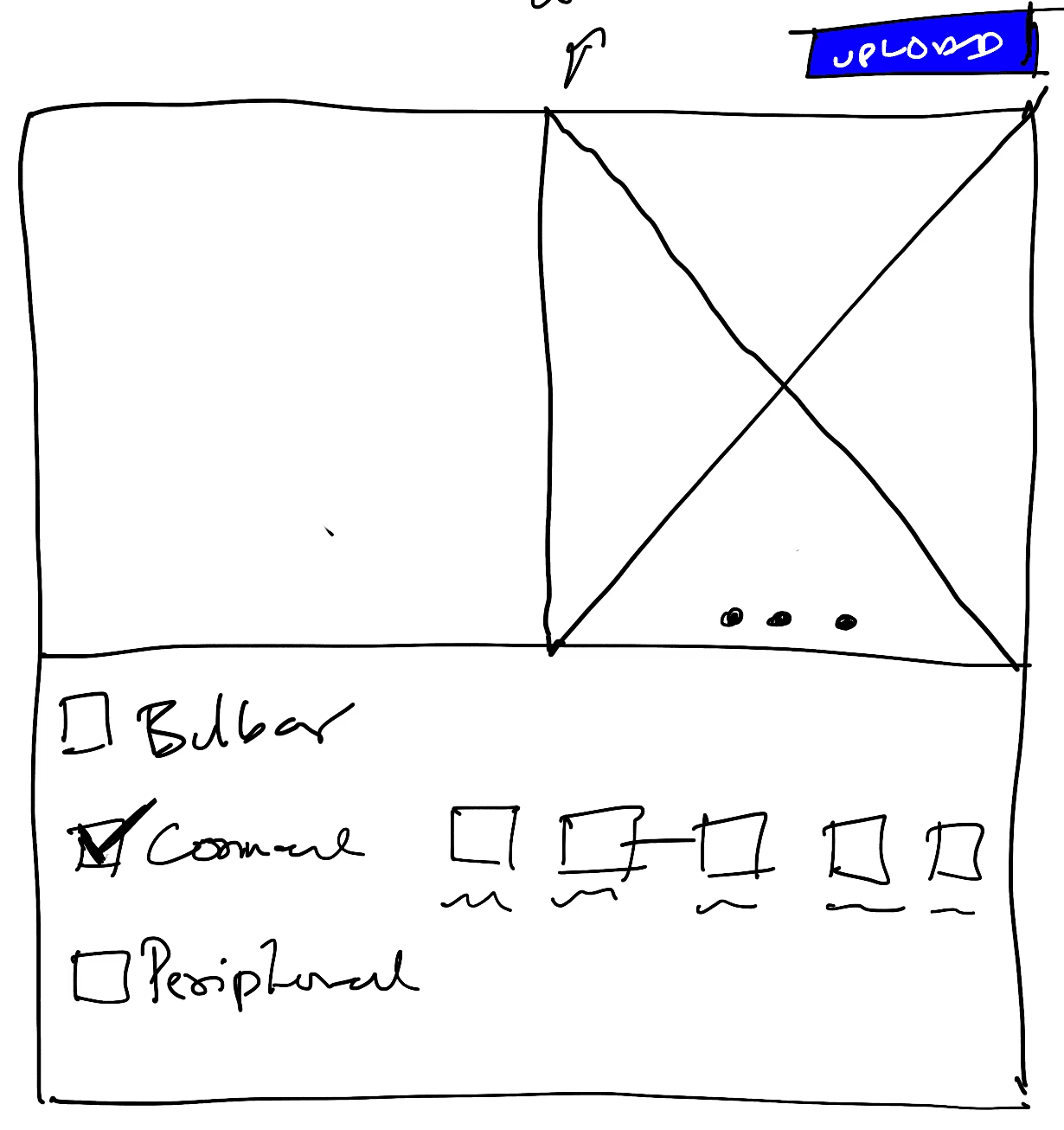
Wireframe sketch for the basic layout

We are currently evaluating AI tools to study uploaded images and recommend the appropriate nuclear, cortical or posterior grade along with reasoning and a confidence score. The final decision is however, in the hands of the practitioner.
Binocular Vision Assessment (BVA) Tests
WHat does it do?
BVA assesses how well your two eyes work together as a team, checking their coordination, alignment, focusing ability, and depth perception to create a single, clear 3D image.
Why is it important?
Identifies issues affecting reading, concentration, and visual processing.
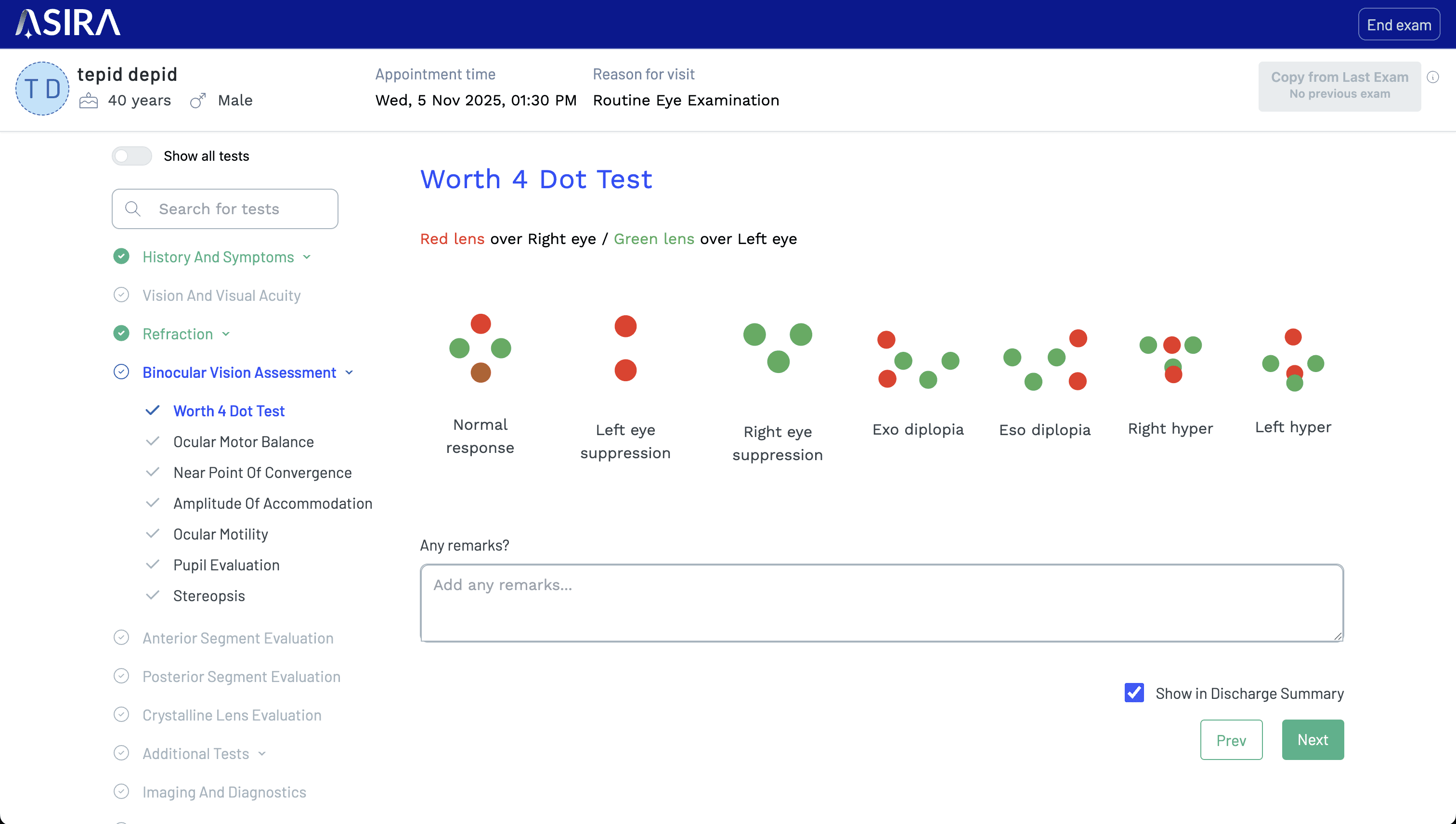
Worth 4 Dot Test
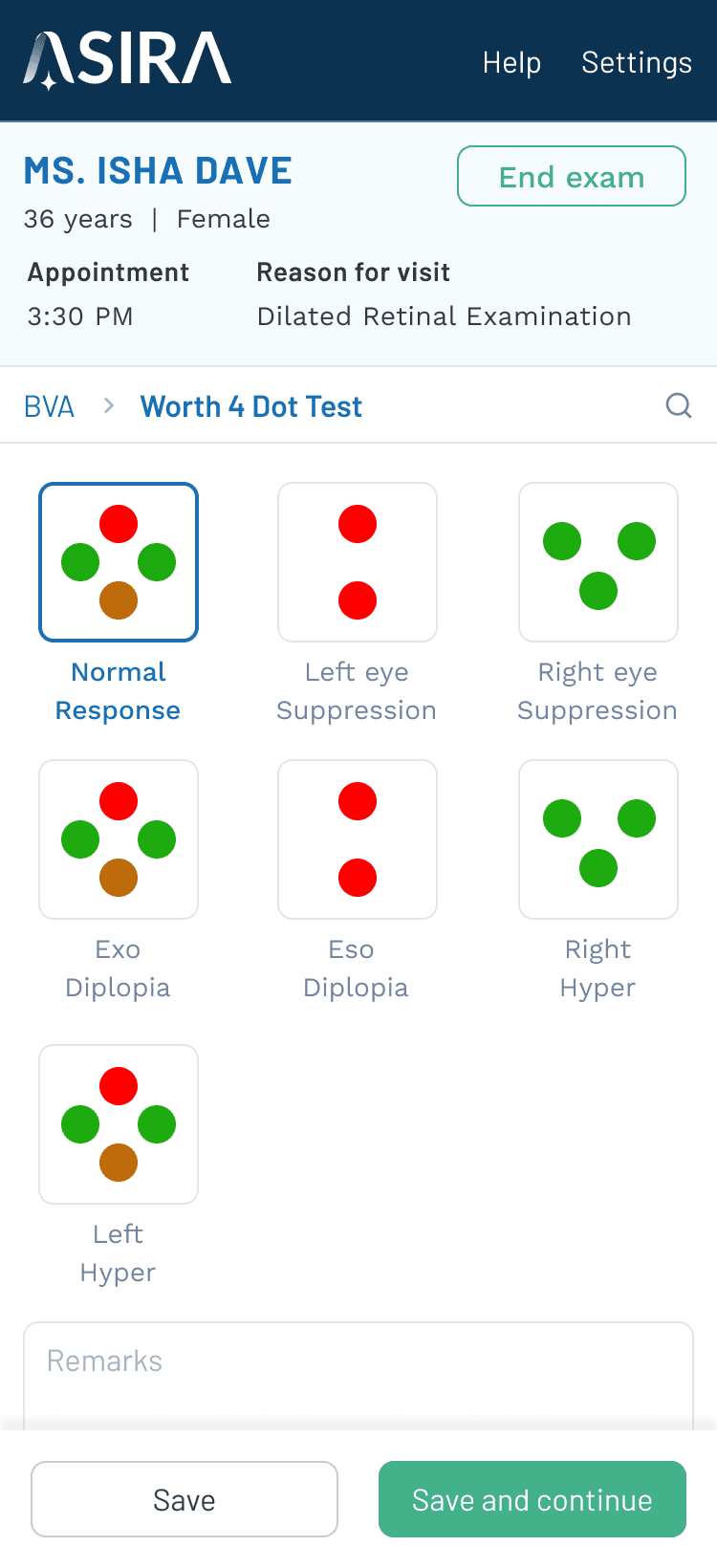
The Worth's Four Dot test is used to assess binocular vision by checking a person's ability to see a single, fused image. It involves a patient wearing red-and-green glasses while looking at a target with four lights, which helps determine if there is suppression (when the brain ignores information from one eye), diplopia (double vision), or normal binocular vision.
Last step
Action and advice
An eye examination is only complete once the practitioner fills out the action and advice - the next steps that need to be taken by the patient. Providing accurate next steps could mean the difference between retaining or losing a patient.
As a result, in most practices, the action and advice is completed by the lead or primary practitioner, even though a junior may have performed the entire exam.
Junior optometrists initially struggle to deliver an accurate action and advice and either need help from a senior faculty, or have to refer to old class notes. ASIRA solves this by using the OpenAI API to review patient history and test data to suggest the recommended next steps.
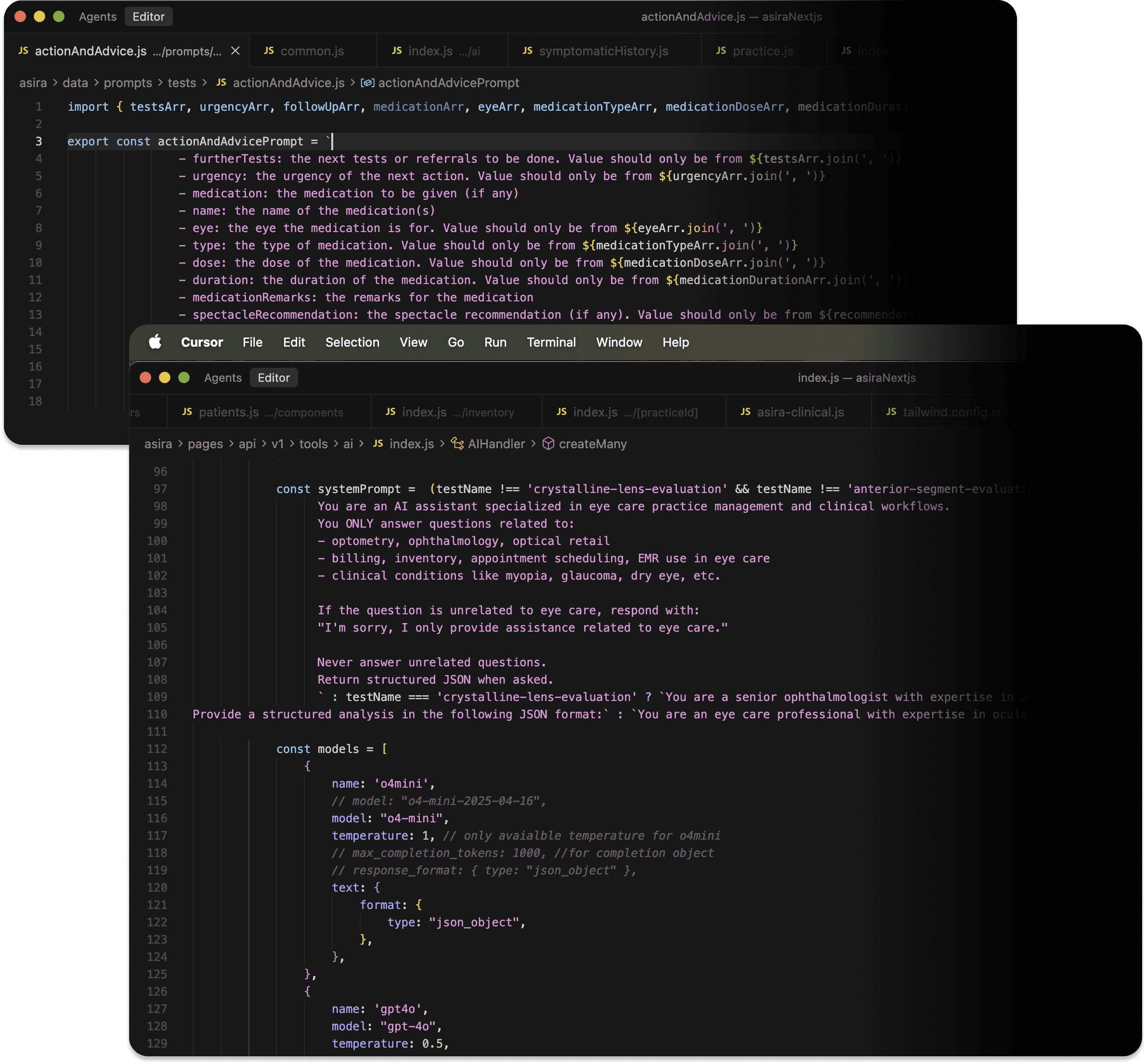
Prompts and a snippet of an output response from the OpenAI API for the Action and Advice.
Mobile Friendly Test taking
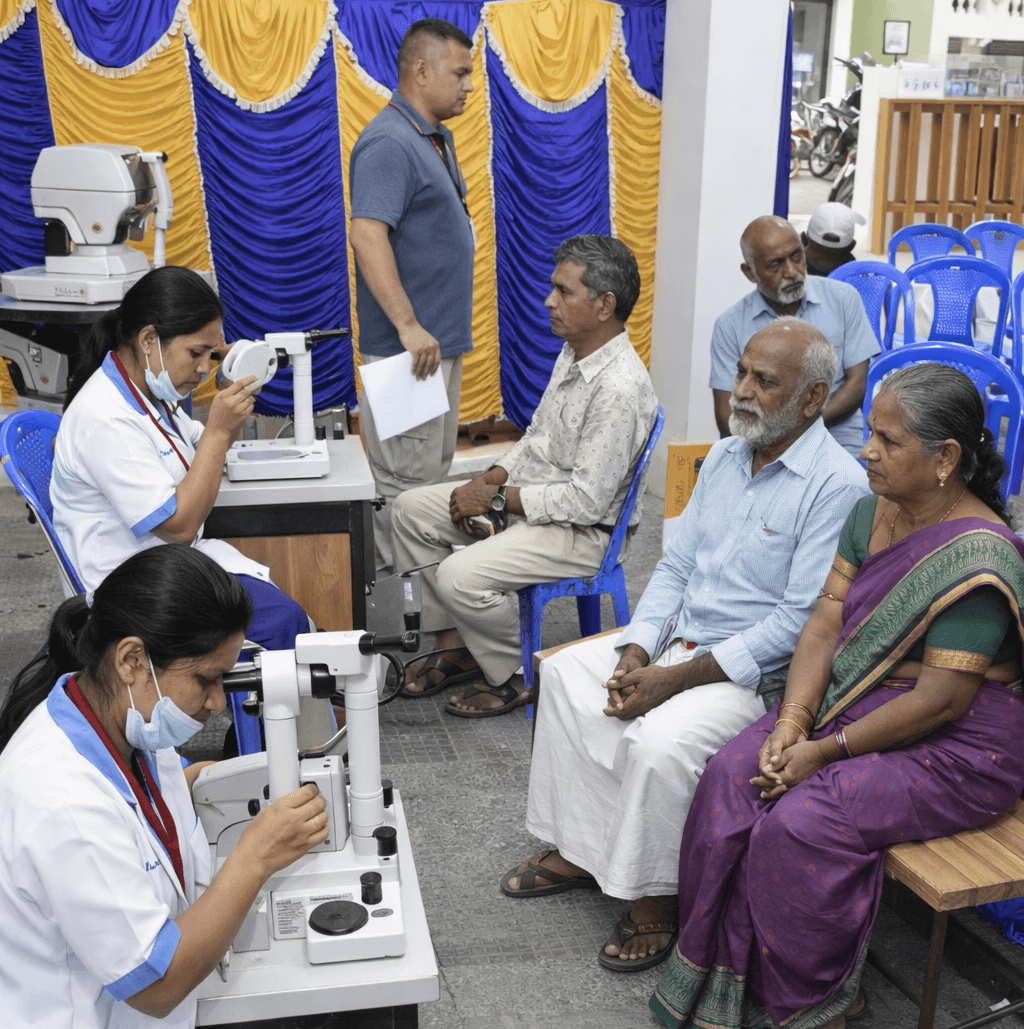
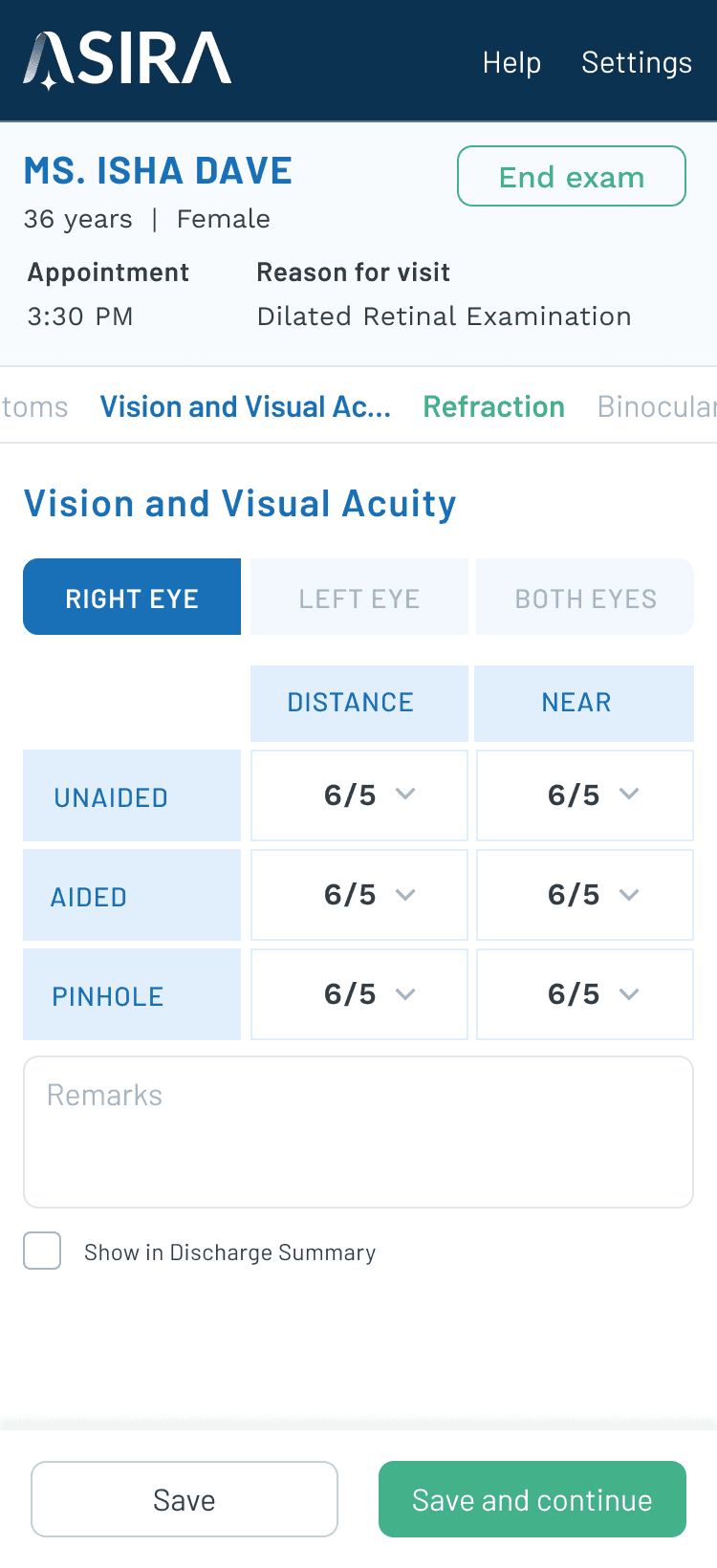
Optometrists often conduct eye camps in rural centres and villages to provide free eye checkups and medication to those that can't afford it. Due to poor network coverage, practitioners either record patient data on paper or as notes on their phone.
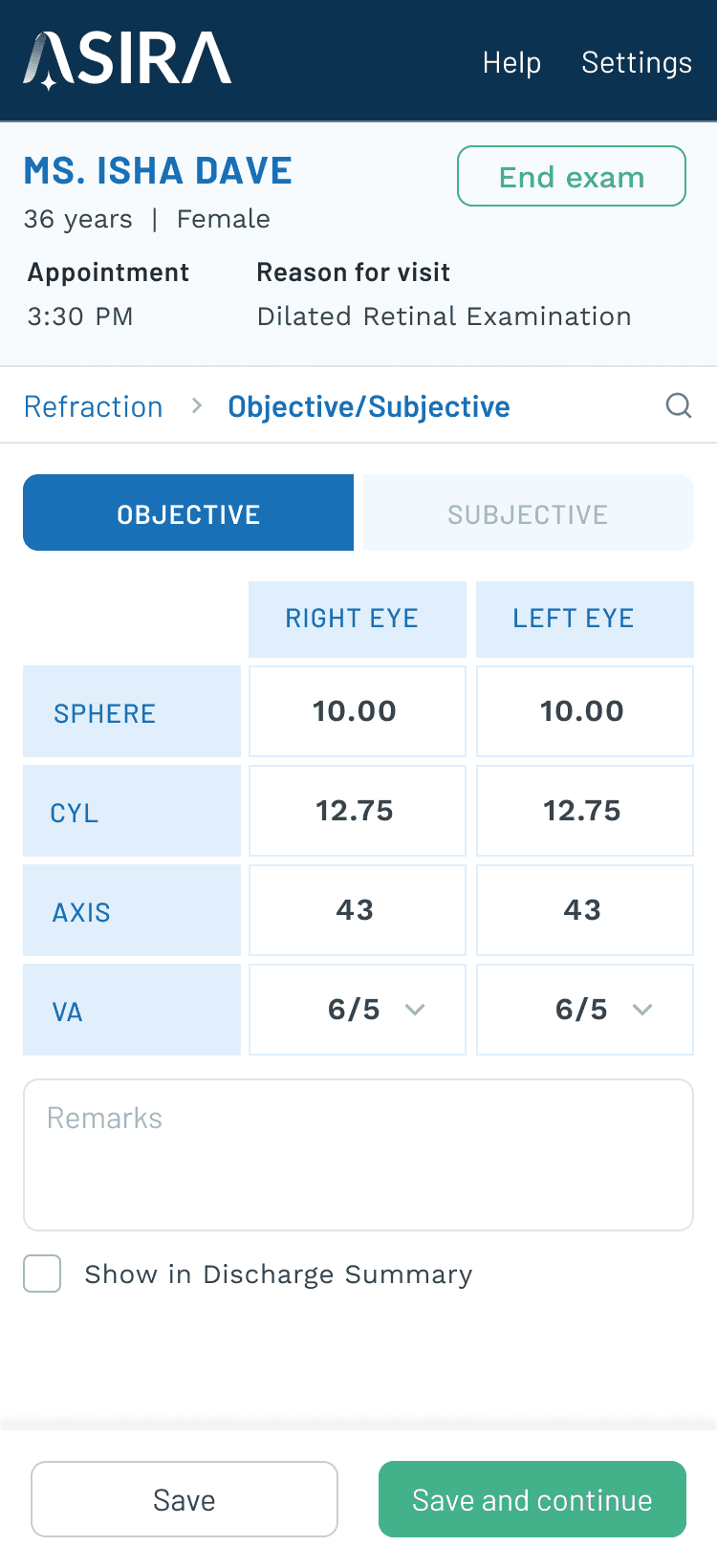
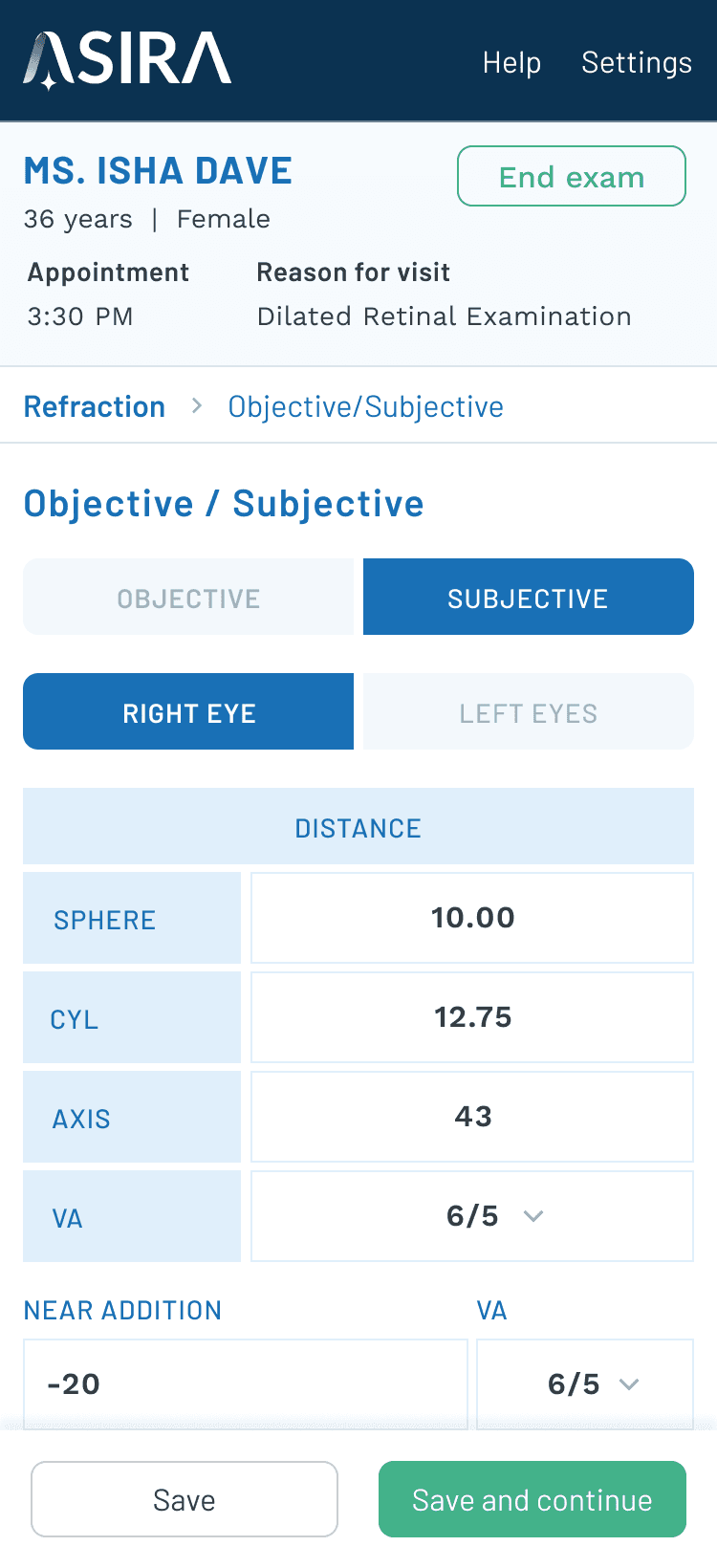
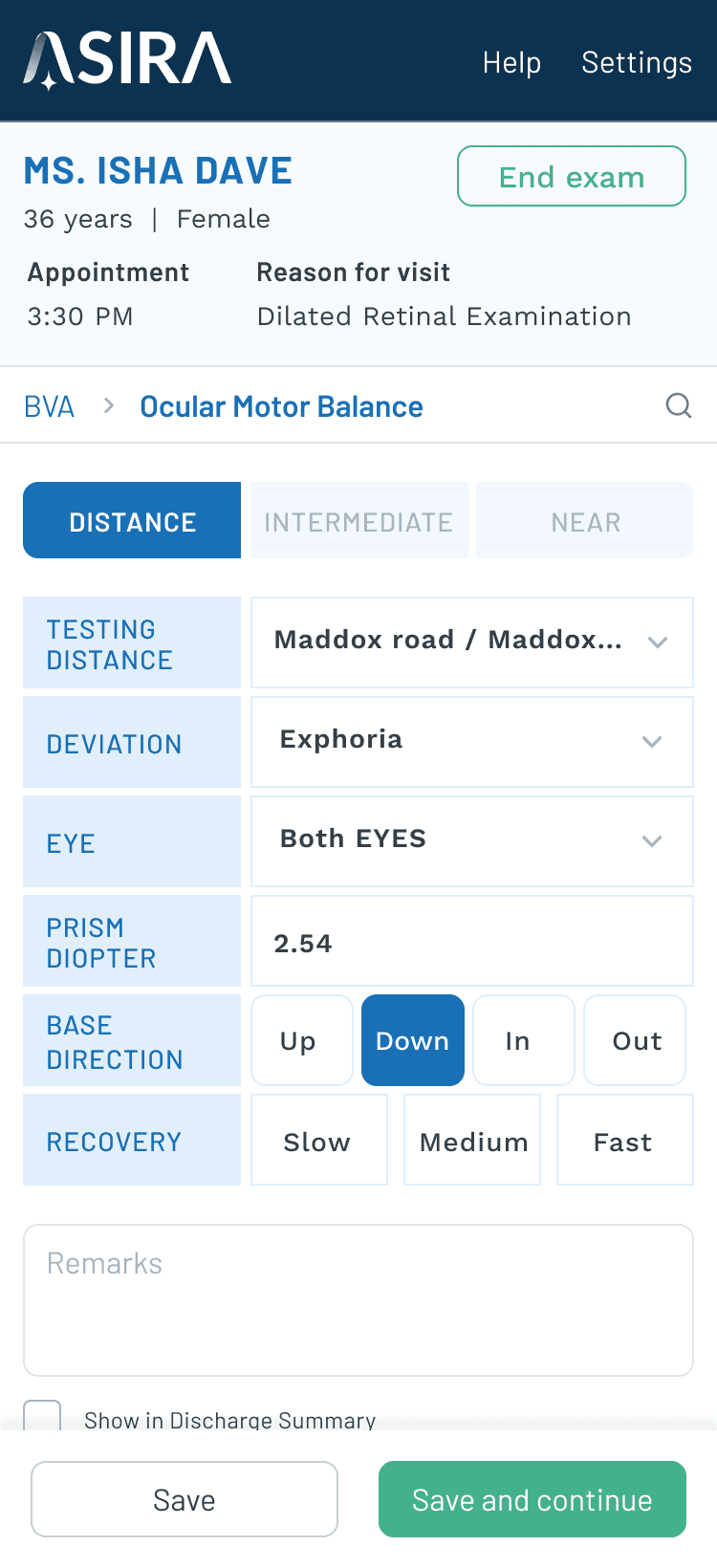
I redesigned all the tests for mobile interfaces to allow practitioners to record patient data directly into ASIRA.
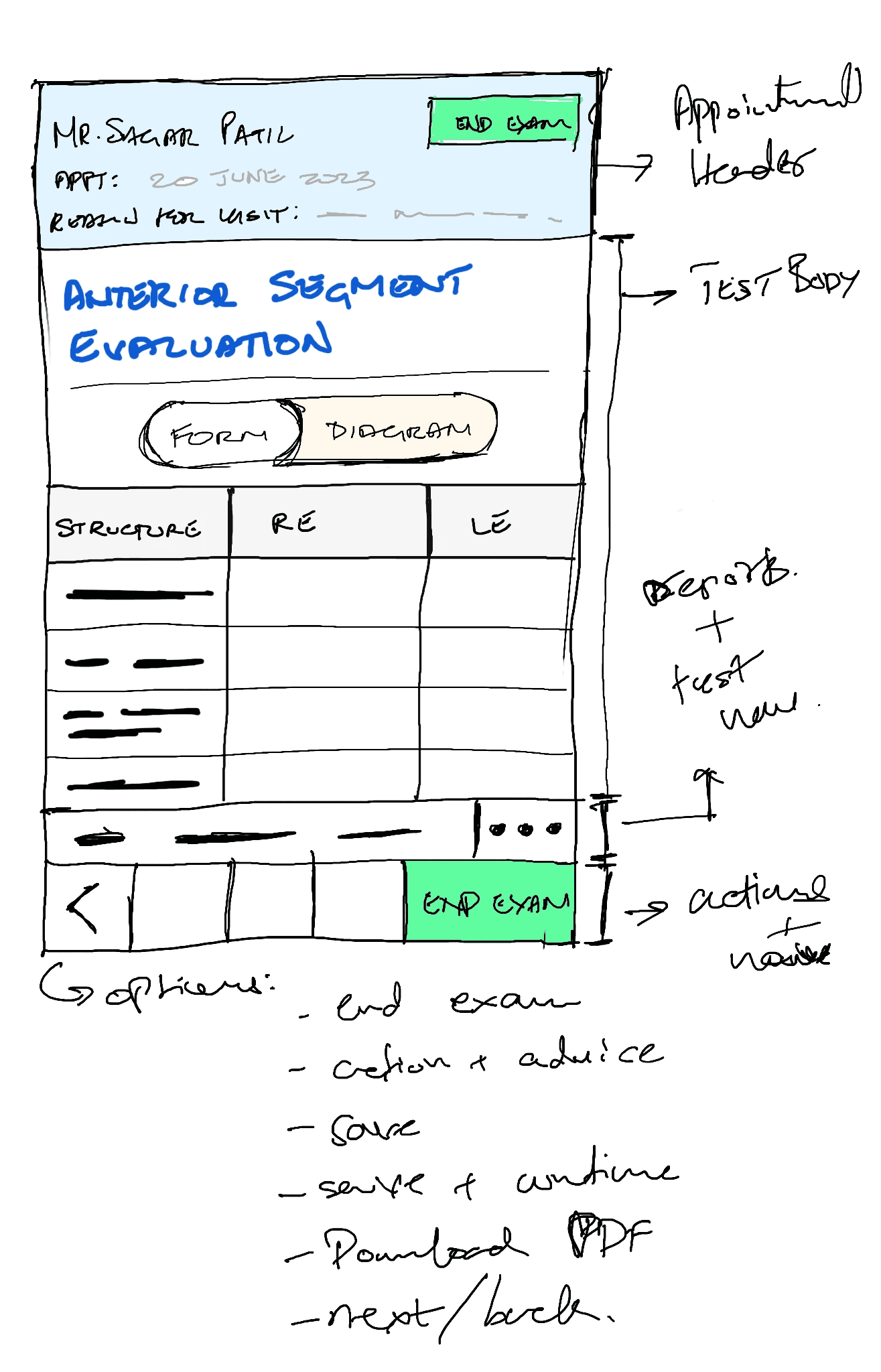
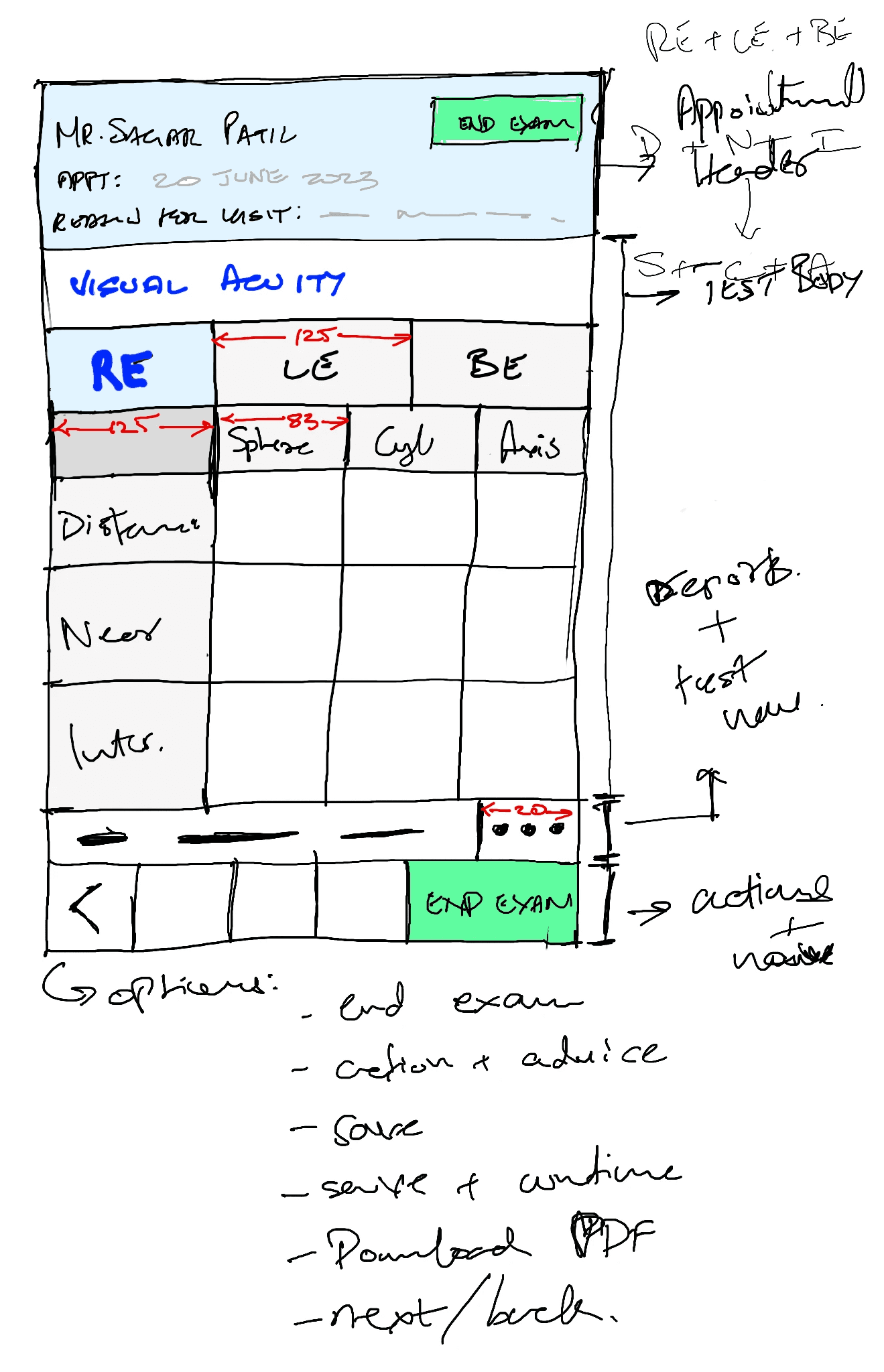
Right: Sketches of how the UI would need to align with breakpoints for mobile devices.
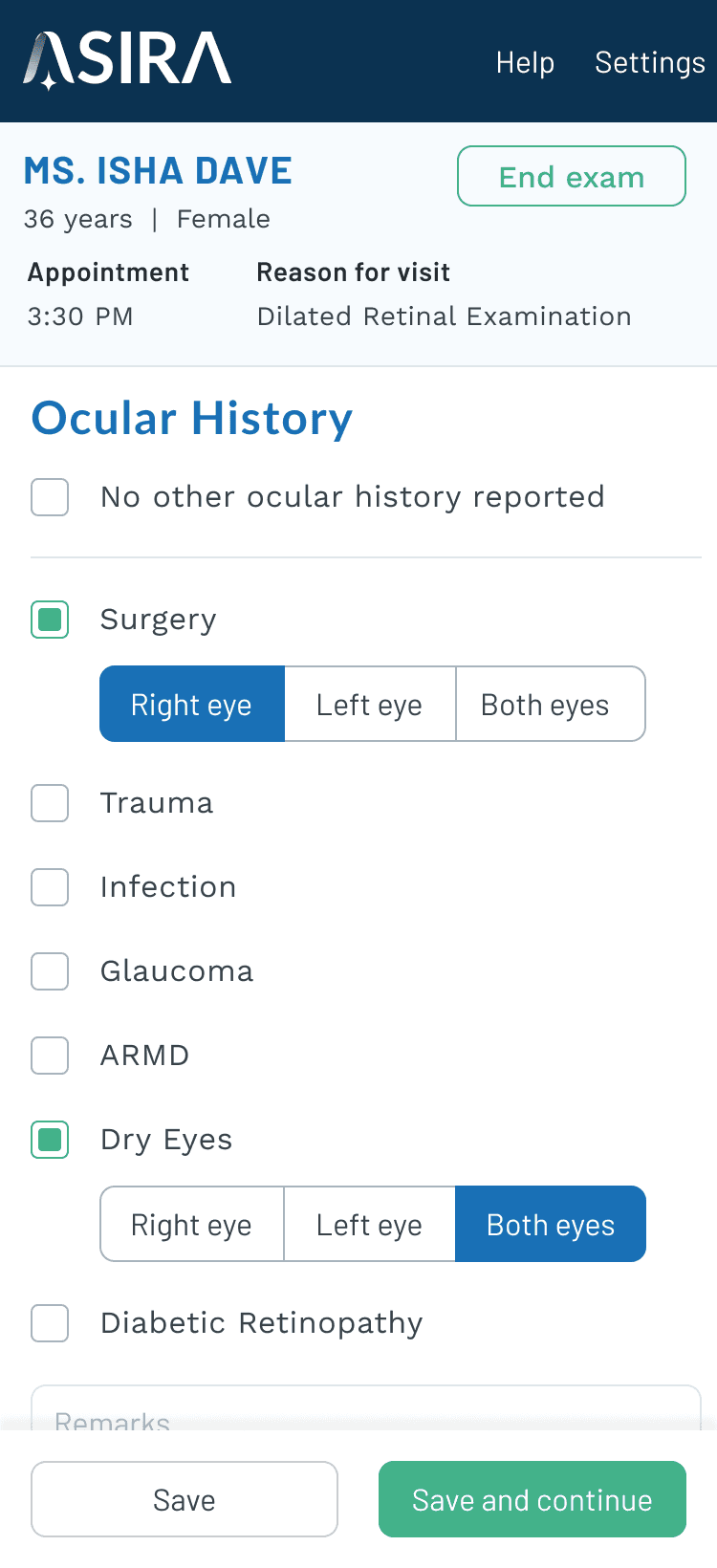
Below: Refined final designs of the mobile version of the different tests. It was a challenge to fit all the tests into a grid hile avoiding a horizontal scroll for large tables.

📣
public service announcement
ARE YOUR EYES FEELING STRAINED FROM READING THIS CASE STUDY?
uSE THE 20-20-20 Rule to feel better.

Take a break every 20 MINUTES.

Look at something 20 FEET away.

Wait 20 SECONDS before returning.
reports
Discharge Summary
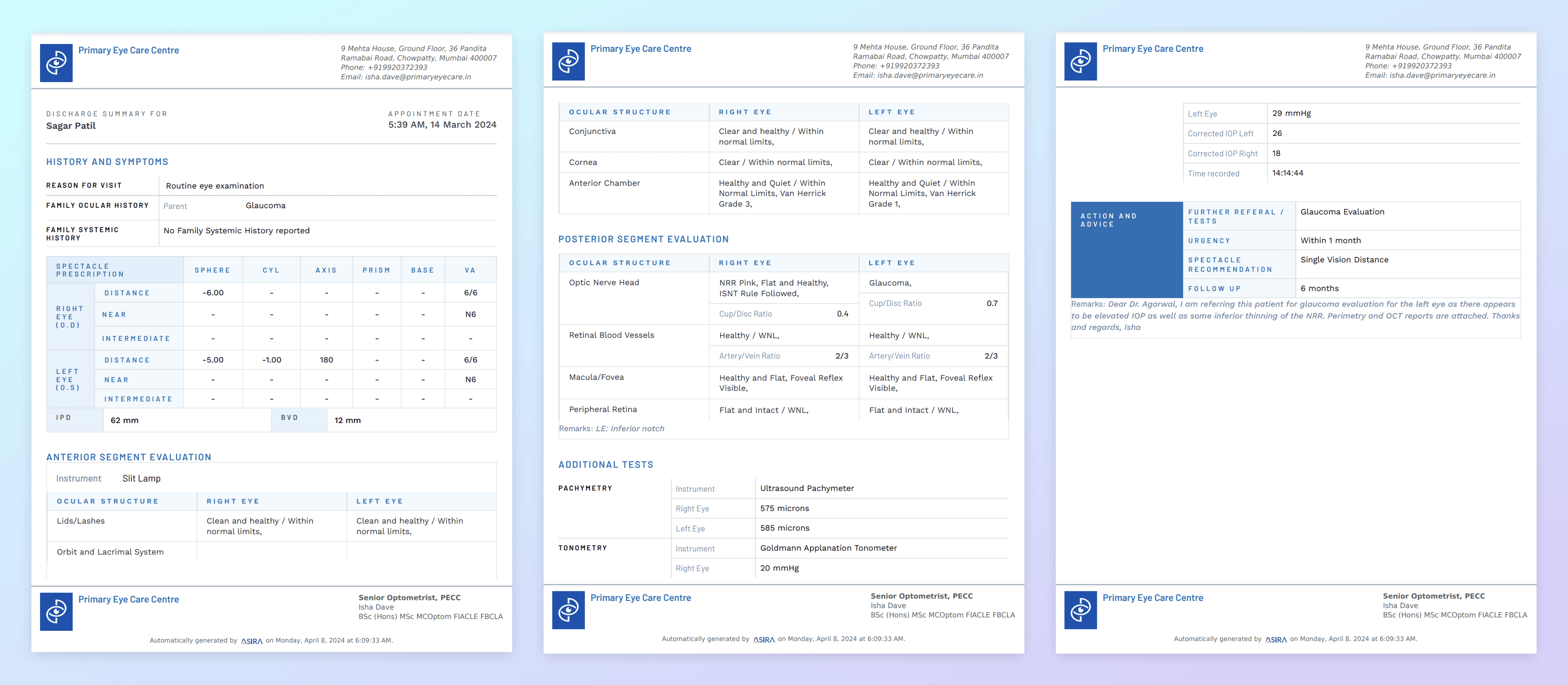
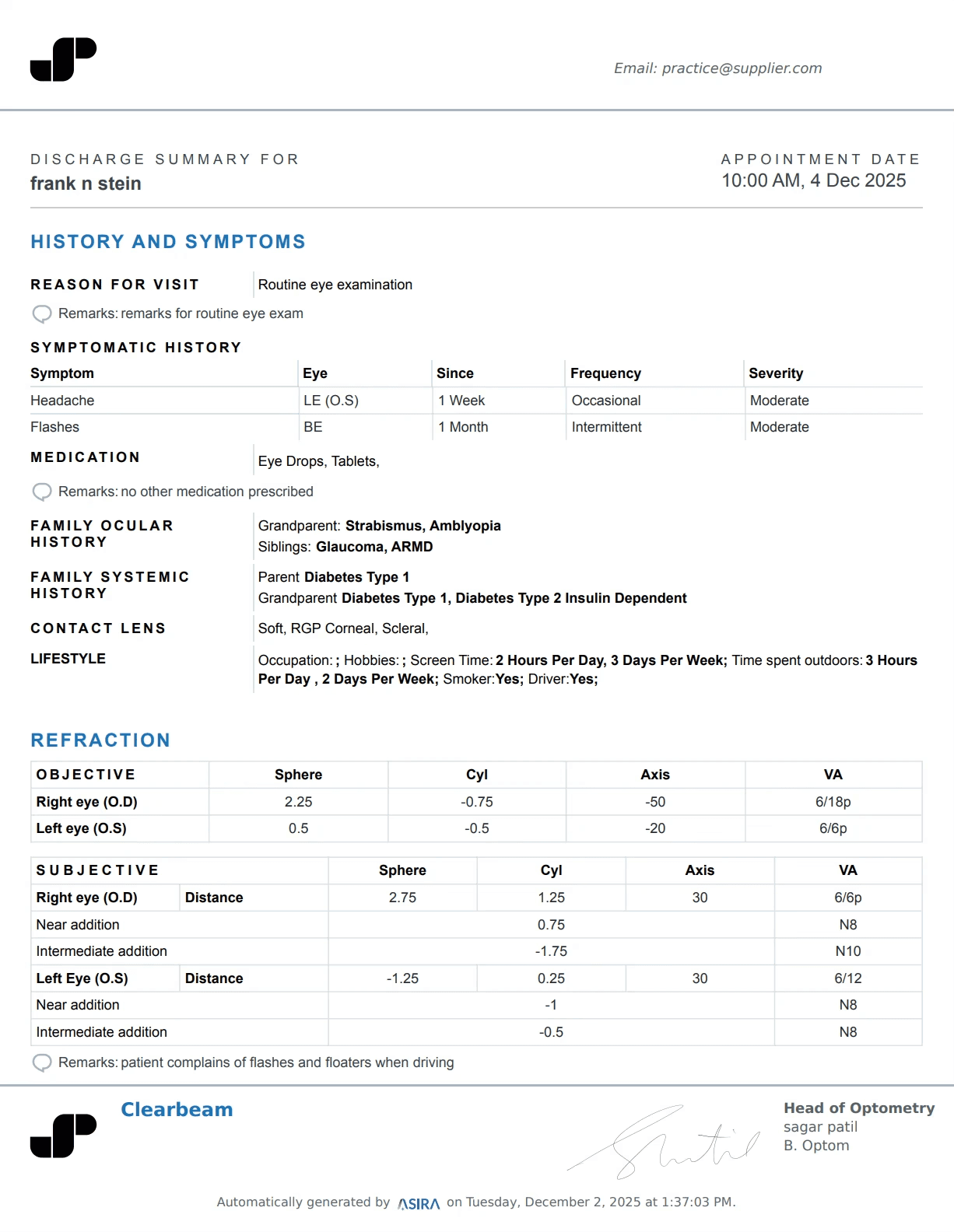
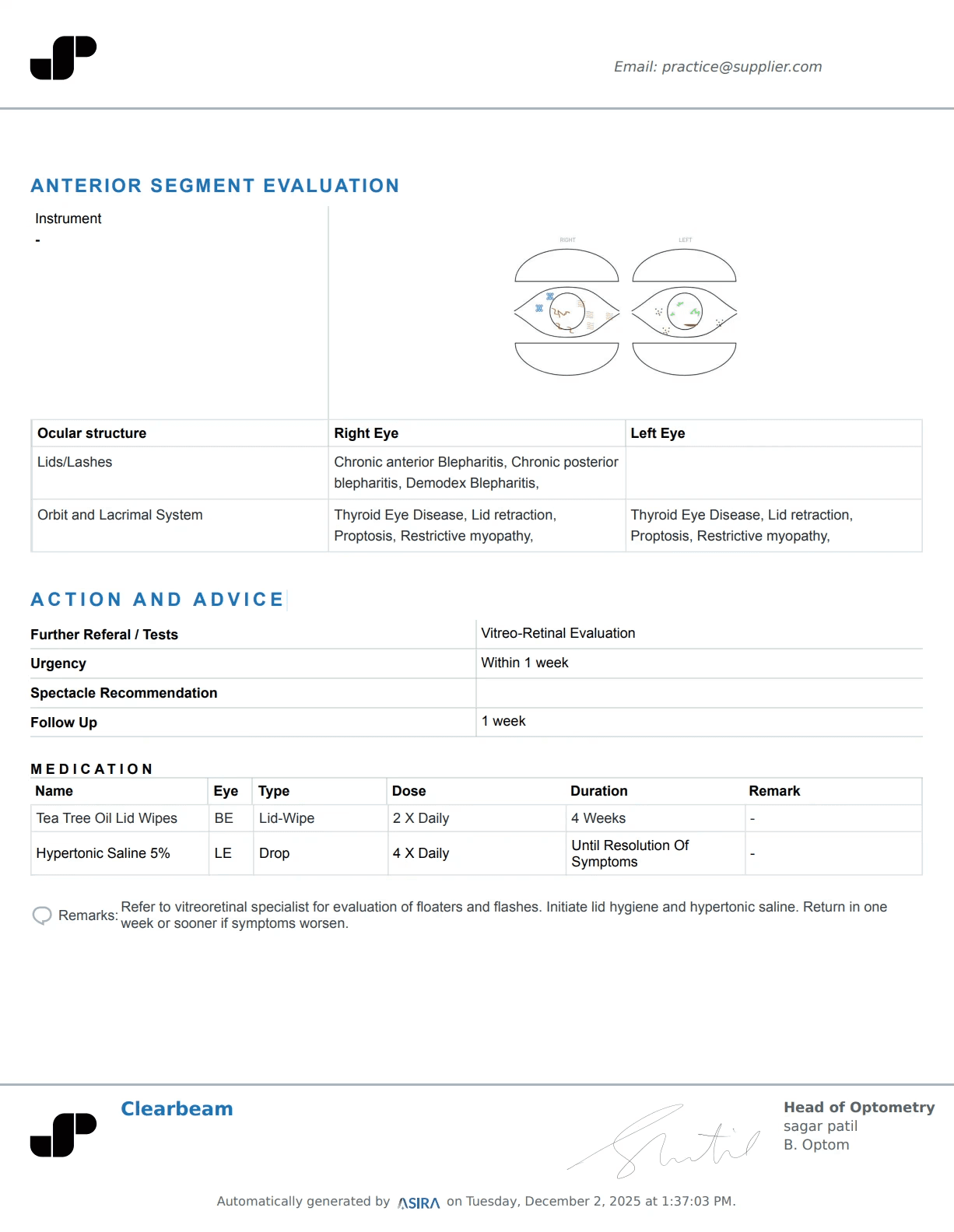
The discharge summary is the final report handed to the patient once an eye exam is complete. This report contains all the information that the practitioner chooses to share with the patient.
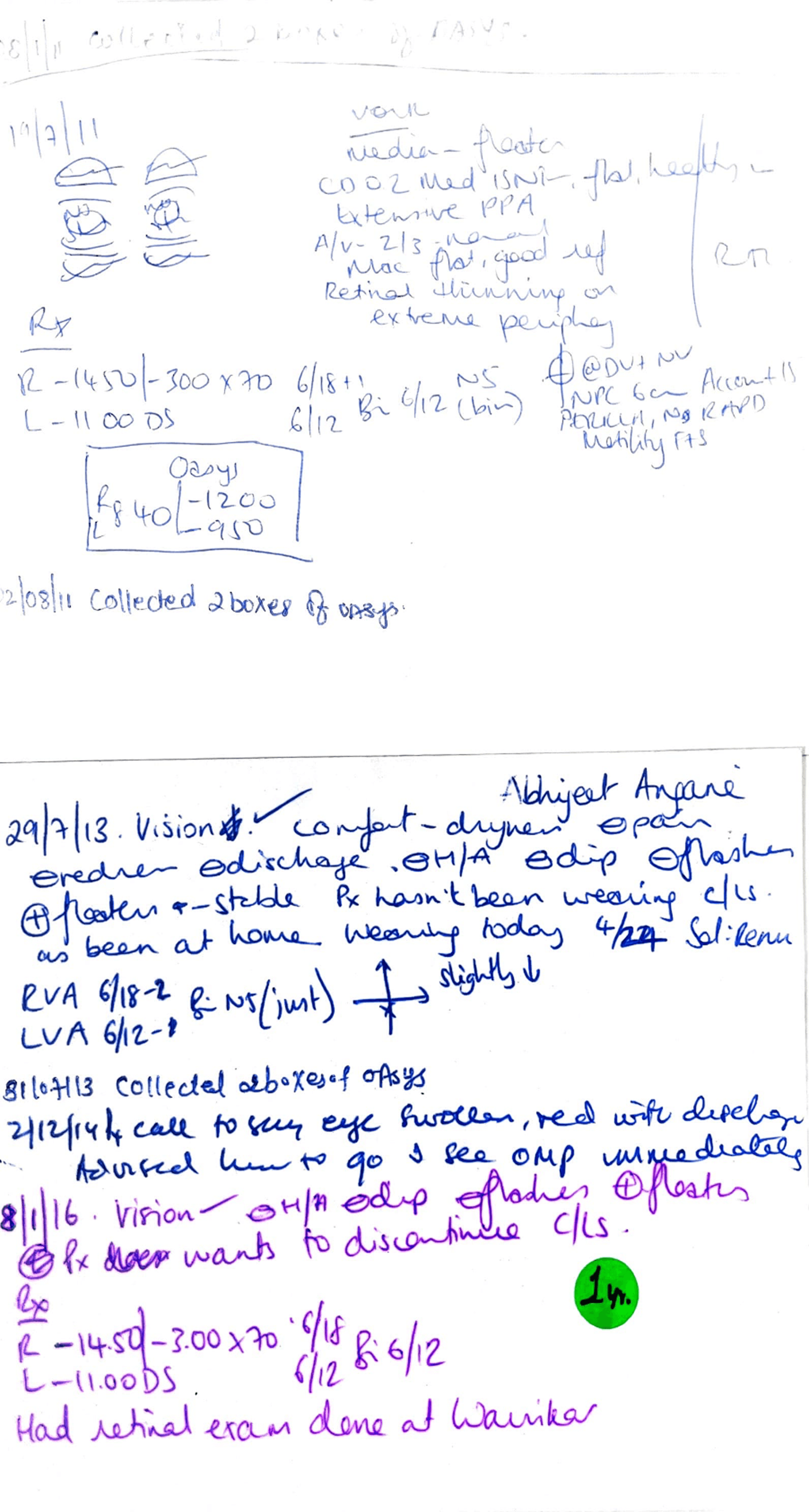
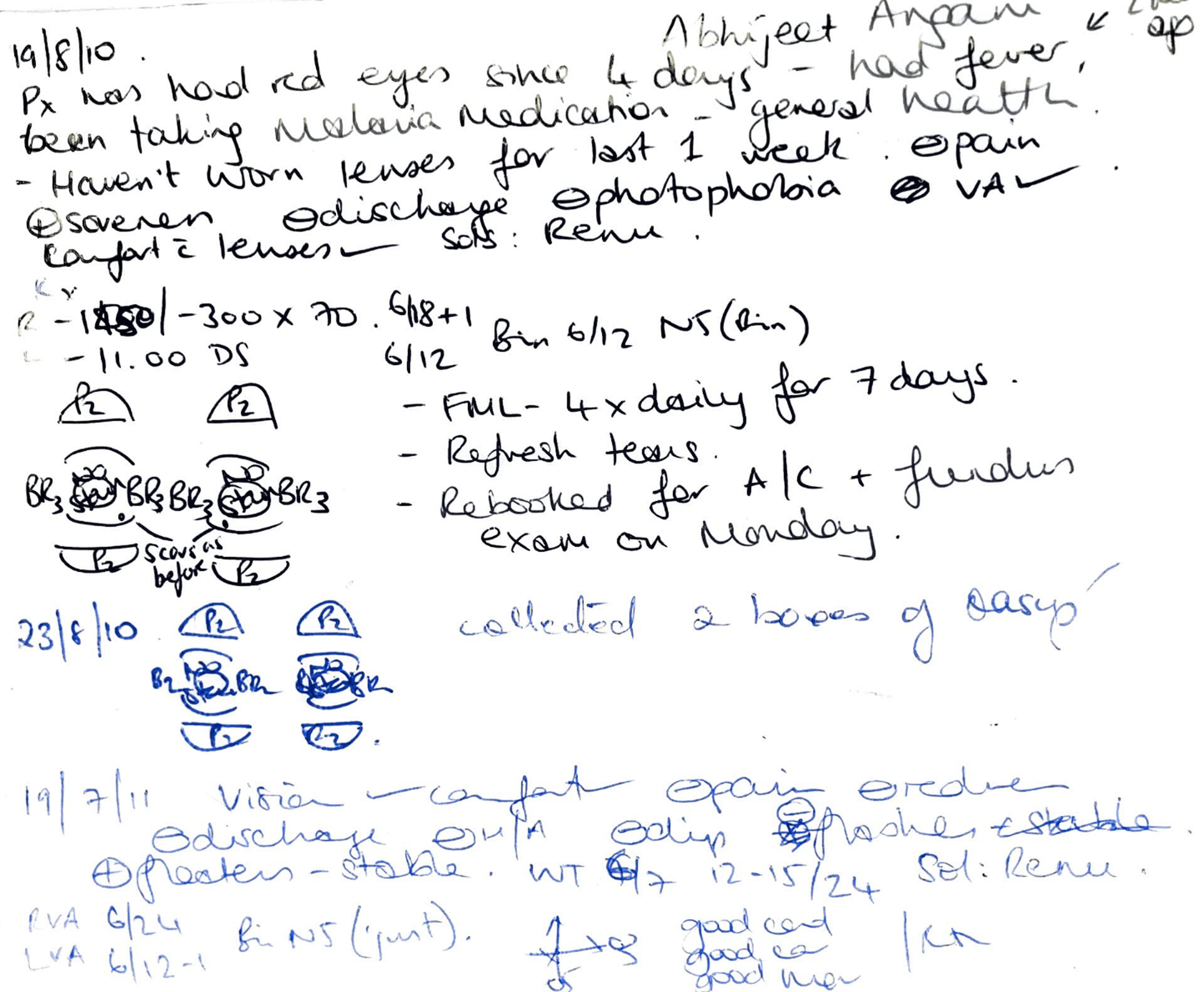
Typical discharge summaries are hand written or scribbled on cards that don't make sense when reviewed later. Even on Rx pads, there is a limit on how much data can be shown.
I designed a standard template for the discharge summary and other reports which would adapt based on the number of tests performed during the eye exam.
With the assumption that patients want verbose reports, I used a base 3-column grid to create unique grid combinations per test to make them more legible.
Learning

After much customer consternation about the number of sheets required to print a discharge summary, I trimmed the font size, leading and spacing, and used only tables or a two column grid.
Though the previous design looked more professional, customers wanted to spend less on paper, even at the cost of legibility.
Final spectacle
prescription
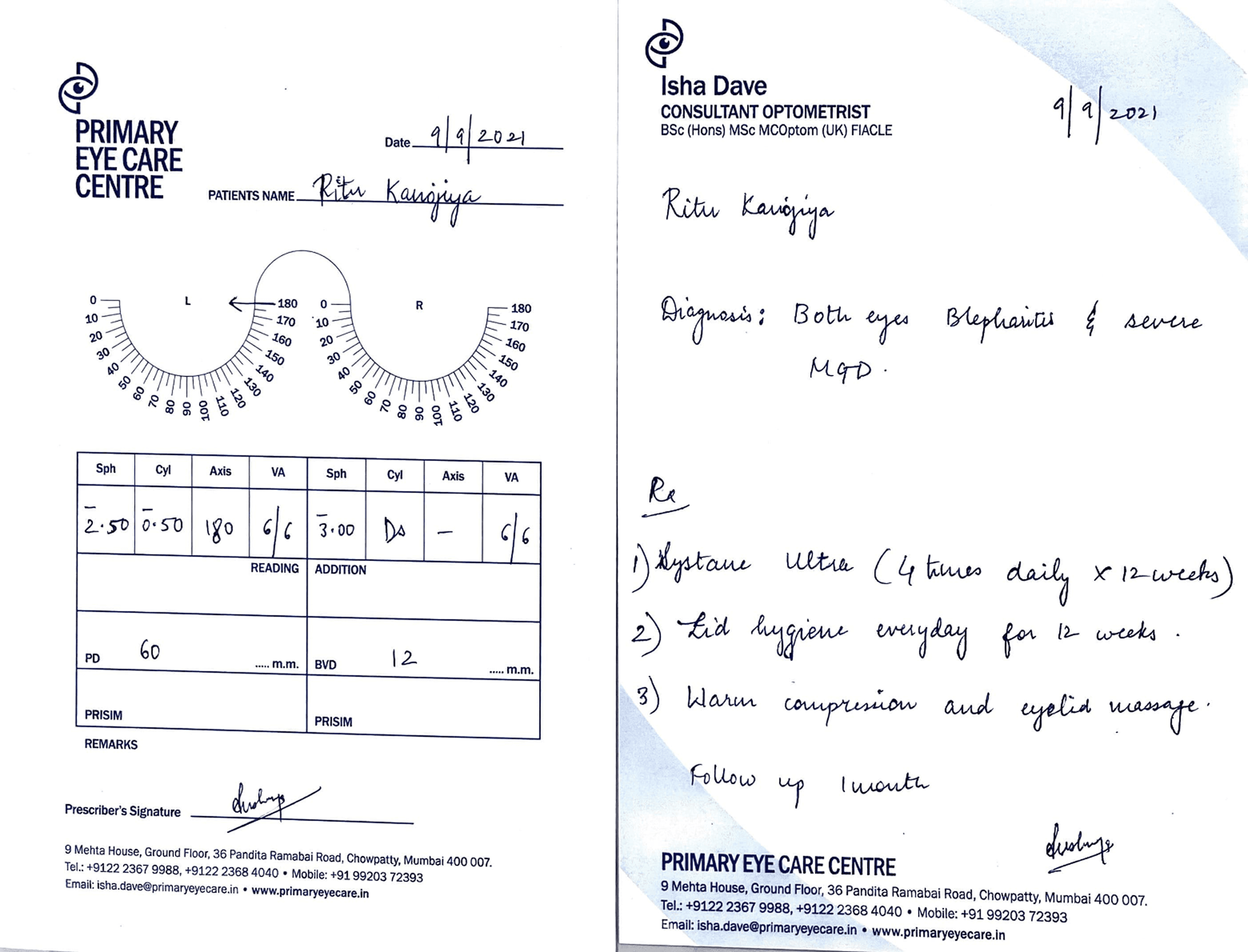
The final prescription that the optometrist gives a patient to get their recommended eyewear.

Outcomes
Since acquiring our first customer in March 2023, ASIRA Clinical is now being used by close to 150 practices and hospitals across India. So far we have booked over 35,000 appointments, recorded 330,000+ eye tests and manage ocular EMR data of more than 35,000 patients.
Learnings
Updated my coding skills to be able to take a B2B product from 0-1
We initially considered outsourcing the engineering since I hadn't coded in over six years. However, as a founder I think it's important to know your product inside out, including how the codebase works.
I taught myself how to think and code in React using Nextjs. In addition, I also integrated Prisma ORM, Postgres, Docker, Ansible, the AWS Stack and myriad client side libraries.
These days, I rely on AI tools such as Cursor, BugBot and ChatGPT's Codex to build and prototype components, APIs and pages. This has helped us rapidly deploy features, updates and bug fixes every week.
Empathise with the team and adapt to everyones different learning curves
As the only engineer and designer on the team, I have to routinely check my expectations of the other members of the team who are not as technically proficient as myself.
Healthcare professionals are generally late adopters when it comes to technology and need extra support and empathy when guiding them through a technical product.
Acknowledgements
ASIRA would not be possible without the combined effort of the engineering, sales and marketing teams. As a small team of three, everyone put in their best work to build India's first eye care specific EMR. A huge thanks to Shirish Kamath for building the initial engineering infrastructure that helps Asira grow and scale with minimal effort.
A big thanks also goes out to Chirag Vyas who interned with ASIRA during the summer of 2023 and who's code is still an integral part of the product.
VISIT ASIRA CLINICAL
Frankensteined in Mumbai.
Fueled by YouTube, 90s cartoons & Heavy Metal.